Showing posts with label Joyce. Show all posts

Tuesday, March 11, 2008

Portrait Model Paper # 5

The True Meaning of Nature in the Life of Stephen Dedalus
Benwit L
English 12 Honors
February 7, 2008

Art and nature can be seen in a contrasting manner. For an artist, to create art is to create an image or an emotion out of nothing. However, nature has a sense of supremacy in which the objects created through nature are part of reality. Artists have attempted to mimic and even surpass the qualities of nature through their techniques. In James Joyce’s A Portrait of the Artist as a Young Man, as Stephen grows up as a budding, young poet, he struggles with the vastness of nature and the superiority it imposes on him. Through Stephen’s artistic journey, Joyce implies that nature is genuine and can not be attained through art. Stephen is only an artist in his adult life once he learns to accept nature.

Through the innocent mind of Stephen, Joyce establishes that nature has a sense of infiniteness. As Stephen opens up his geography notebook, he reads the writing on the inside and tries to interpret it artistically by reading the verses backwards. Initially, Stephen writes:
  • Stephen Dedalus is my name,
    Ireland is my nation.
    Clongowes is my dwellingplace
    And heaven my expectation. (27)

By referring to the places as his dwellingplace and his nation, Stephen suggests that he holds some position of power in the areas and further strengthens his image. His pseudo poem dramatically ends with “Stephen Dedalus is my name” (28). The other statements give Stephen a sense of importance which heightens the effect of stating his name last. In his attempt to gain status, he is trying to compete with his surroundings which, in a psychoanalytic sense, are the father figures which are constantly hindering him. Stephen is a part of each of his environments, much like how a son resembles his father and, therefore, Stephen feels much of the oedipal uneasiness that prevents him from becoming a man on his own. Stephen does not feel as if he belongs in his environment because he lacks a definite connection to it like he would with his mother and thus wishes that he is the father figure for this brief instance. He knows that he is in Clongowes and Ireland; however, he is unable to adapt and feel comfortable like the other boys. Stephen can not help but to try to become his father. He lacks composure that the other boys seemingly have and is still very much infantile in his behavior. He continues to seek comfort in his art, treating art much like the physical connection he once had within his mother’s womb.

Although one can interpret meaning in the backwards verses, Stephen himself acknowledges that “they are not poetry” (28). In his artistic act, Stephen contemplates on what true importance he has on the world. He wonders what is beyond the universe and can think of nothing. He then speculates if there is “anything round the universe to show where it stopped before the nothing place began” (28) and if “there could be a thin thin line there all round everything” (28). Ultimately, Stephen concludes that “only God could do that” (28). God, the ultimate creator and nature itself, is the only one that has the power to do such an action. In a sense, His importance is above the importance of all others, including artists such as Stephen. God is typically referred to as a male, dominating figure, perhaps the greatest father figure that one can imagine. Stephen’s relationship with God is much like his relationship with his own father. Despite Stephen’s efforts in gathering his mother’s attention, he is unable to compete with his father, much like how Stephen is unable to compete with God, both in importance and in art. God and Stephen are both creators, a connection that creates even more competition for Stephen and only makes God seem even greater a paternal threat. At such a young age, Stephen already establishes the insurmountable gap between himself and God. No matter how hard Stephen tries to create his art, God will always be there with superior creations, aware of Stephen’s sins and looking down upon him. This gap eventually develops his fear of God as a punishing, unforgiving father figure during his adolescent years. Even without the presence of his father, Stephen continues to be pressured by a father figure, one even greater than his own father. In an attempt to create purpose for himself, Stephen unintentionally ends up mentally castrating himself but, through his castration, he gains a better understanding of the immeasurable aspect of nature and respect toward God as an artist.

If one were to assume that nature is inclusive of all things occurring naturally, then one can believe that human emotions are included in the bigger scale of nature. Like other instances of nature, emotions can not be emulated as simply as artists think. Stephen, inspired by his brooding, yearns to write a poem full of feelings of passion yet he finds himself unable to. With the intent of intensifying his emotions, he removes parts of the scene which “he deemed common and insignificant” (74). In his emotionally driven poem, “there remained no trace of the tram itself nor of the trammen nor of the horses: nor did he and she appear vividly” (74). The lovers in his poem are no longer of Stephen and EC but two unnamed protagonists. What remains is “the night and the balmy breeze and the maiden luster of the moon” (74). His poem is filled with emotions and the images he creates give the reader a glimpse at Stephen’s feeling. However, Stephen obfuscates his magical moment far too much. The elements that Stephen believes are too ordinary are what also make the moment. Without any hint of the real aspects of the scene, Stephen’s poem becomes only a description of a nearly surreal landscape. In Stephen’s attempt to recapture the moment it is unlikely that any of the truth is retained. Nothing within Stephen’s image is natural, feelings or setting.

As Stephen yearns for EC, “he senses that the object of desire is one with which he has somehow been familiar for a long time, one he knew in the ‘dim past.’ It is his mother” (Brivic 286). The woman in his poem is no doubt his mother and the man, though unnamed, is who Stephen wants to be. Stephen writes his poem to feel masculine, to show that he is capable of love toward another. However, he is unable to fully envision himself kissing his mother because he feels that he can not fulfill the role as a father and that the actual thought of making his mother into a sexual, approachable figure is wrong. Stephen is demasculated by his failed attempt, knowing he can never be his father, and quickly turns to shame. The imagery Joyce depicts is suggested to be feminine by the “maden luster of the moon” (Joyce 74). Brivic also writes that Joyce’s imagery “associates [Stephen’s] image with the womb, and he associates it too with tenderness and security” (Brivic 286). A child is unable to properly recall the experience of being inside the womb, hence Stephen’s vague and hazy descriptions. However, the same child is physically part of his mother, allowing him to feel a sense of comfort. Unsatisfied by his subconscious attempt to recreate the environment and becoming his father, “he [goes] into his mother’s bedroom and [gazes] at his face for a long time in the mirror of her dressingtable” (Joyce 74). This unnatural behavior is no doubt caused by his oedipal fixation with his mother. “Freud describes how many boys cultivate ideal, desexualized visions of their mothers” (Brivic 287). Young Stephen views EC as an untouchable goddess of sorts. He is unable to physically approach her and attempts to create art to be with her in his fantasies but he subconsciously finds himself regressing toward oedipal instincts and his attachment to his mother.

In the end of the novel, Stephen discusses his plans for the future as an artist with his companion Cranly. Ideally, Stephen wishes “to discover the mode of life or of art whereby your spirit could express itself in unfettered freedom” (217), an idea that Cranly struggles to comprehend. Cranly questions Stephen, asking Stephen whether he would deflower a virgin or not, curious with what kind of response he would give. As Cranly asks for Stephen’s opinion, “[Cranly’s] last phrase, soursmelling as the smoke of charcoal and disheartening, excited Stephen’s brain, over which its fumes seemed to brood” (218). Joyce once again uses the word brood to describe Stephen’s passion for women. Stephen however is able to control his once-rampant feelings and respond calmly, and states:

  • I will not serve that in which I no longer believe whether it call itself my home, my fatherland or my church: and I will try to express myself in some mode of life or art as freely as I can and as wholly as I can, using for my defense the only arms I allow myself to use, silence, exile, and cunning. (218)

Although he does not give a direct answer, unlike the childhood Stephen, the older Stephen is no longer trying to defy nature. Part of Stephen must understand that he still has these natural yet sinful desires. Despite this, he approaches his life with sociological imagination, looking at himself as an individual in a vast world and distinguishing himself from society to develop a mindset free from the harmful influences of society. These influences of society are the paternal threats that restrict the young Stephen, that cause him to be mentally castrated. They cause Stephen to act upon oedipal feelings, threatening Stephen and restricting his potential as an artist. Rather than elevating himself above his paternal threats, he merely wishes to defend his mind, freeing himself from thoughts imposed by others. He does not want to prove a point to society and acts solely on his own accord.

Stephen now has no fear of consequences and does not fear being alone. One can argue that being alone will cause one to act on instinct, becoming more in tune with nature. Stephen considers his oedipal feelings as unnatural, that they are only natural because human interaction has made it so. He believes that there is a state of mind more natural than that following human nature. Human nature in a typical sense deals a great deal with one’s surroundings and emotional situations. By isolating himself from the people around him, Stephen is able to attain this nature mindset that surpasses human nature, therefore, being able to achieve the greatest level of art.
Joyce states that Stephen’s development is a rhythmic curve and that each triumph is followed by a fall. Stephen becomes aware of his inevitable fall. By becoming an artist from an entirely new approach, Stephen is, in fact, embracing nature rather than trying to manipulate it. He strives to attain a new level of consciousness of his environment and breaks away from the urge to become a father figure through his new awareness and thus is able to concentrate on his art.

Joyce tells the reader that recreating nature will end in vanity through Stephen’s failures. Joyce chooses the intellectual Stephen, an aspiring young artist, as the protagonist. The young Stephen is driven by the goal of all artists: to express a certain scene or emotion. As skillful as he is at his art form of choice, he is still unable to overcome the conflict between art and nature in all senses. However, the older Stephen, who is able to accept nature as it is, is able to continue growing as an artist. “He aims to re-form human consciousness by bringing a new awareness of mind through self-exploration” (Brivic 297). He no longer desires to use art as a link between himself and his mother and create an impossible fantasy. Artists should not try to become creators and should instead try to comprehend nature to the fullest extent. Nature should not be mimicked but should be left the way it is, just as portraits do not exaggerate features; rather, portraits leave them the way they are.

Monday, March 3, 2008

Portrait Model Paper # 4


Stephen Daedalus’ Flight from Female Influence
Christina H
Mr. Gallagher
English 12 Honors
February 5, 2008

In A Portrait of the Artist as a Young Man, James Joyce marks Stephen’s bildungsroman by his efforts to break away from female influence. According to feminist critic Suzette Henke, there are three types of mothers: the biological, the ecclesiastical, and the country--all whom Stephen wishes to cast away. Stephen begins to shy away from the warmth of his mother that he was once attracted to. Joyce uses imagery to allude Stephen's unpleasant psychological return to the womb. Stephen realizes that all women--the Virgin Mary, his mother, and the prostitute--have the ability to give birth to life. Recognizing the gender differences, Stephen separates himself from the women yet the women become Stephen's source of inspiration to create art. Joyce makes allusions to the myth of Daedalus and Icarus to show Stephen's ultimate flight.

At Clonglowes, Stephen is introduced to a world of masculine competition, where he has to live by the ideas of social Darwinism. In order to survive, Stephen must adapt to his new environment and fit in with the rest of the boys. When the bully, Wells, teases Stephen for kissing and not kissing his mother before he goes to bed, Stephen feels “his whole body hot and confused” (Joyce, 27). Joyce uses heat to describe Stephen’s embarrassment and nervousness. When the body is hot, sweat and feelings of discomfort often follow. Stephen does not see any harm an innocent kiss. He assumes that all boys kiss their mothers goodnight before going off to bed. However, the other boys laugh at his behavior, so Stephen begins to question whether his actions are acceptable or unacceptable. “Stephen tries to laugh with them (27). Stephen tries to blend in with the other fellows, but, unfortunately, he realizes he is different from them, because he is the weaker vessel. Stephen’s physical appearance is not as strong and built as the other boys, so he is an easy target for bullies like Wells. Stephen does not challenge Wells; “He [does] not raise his eyes to Wells’ face” (27), because he feels inferior. Since Wells is the “third in grammar” (27), Stephen is convinced that “Wells must know the right answer” (27). Ranks and positions only serve to represent the competitive masculine society, where Stephen places himself at the lowest level.


Without protection and guidance from his mother, Stephen feels abandoned and unprepared to face the real world. When “Wells shouldered [Stephen] in the ditch the day before,” “all the fellows said” “it was a mean thing to do” (27). However, not one of them stands up for Stephen at the scene. The absence of support from the rest of the boys, show that actions like Wells’ are socially acceptable in the masculine sphere. Stephen is discouraged from snitching and forced to accept his place in society. Joyce also uses the ditch to symbolize the womb. The “cold slime of the ditch covered his whole body” (27) as Stephen emerges. By pushing Stephen into the ditch, Wells is attacking Stephen’s masculinity. Stephen is pushed back to his mother’s womb because he is not strong enough to survive in the male-dominated world. Joyce creates an image of Stephen being born. When a baby enters the real world, he is wet and cold. In addition to these conditions, he feels like a foreigner in the new place surrounded by unfamiliar faces that laugh at him. The feeling of coldness represents the harsh realities that Stephen now must face. Stephen longs “to be at home and [to] lay his head on his mother’s lap” (25). Only when he is with his mother or in the womb does Stephen feel the warmth and security he seeks. Stephen sees his mother as a “powerful and beneficent source of physical pleasure” (Henke, 318). She provides him with food, changes his diapers, and bathes him, so Stephen grows up accustomed to her taking care of him. He expects her to always be there to cater his needs. His expectations are crushed by the reality that hits him at Clonglowes as he is forced to be independent.


Stephen’s dependency on his mother lessens as he begins to feel restricted by the religious rules that he has been taught to abide by. After listening to a long lecture, Stephen returns to his room immediately after dinner. Stephen awakes in the middle of night and mentally shouts, “Help” (Joyce, 128)! Joyce uses an exclamatory sentence to express an urgent tone. The cry for help means that Stephen admits that he is in danger and that he is stuck in an undesired situation where he wishes to be freed. The shout results from Stephen’s unconscious state of mind—his dreams. Too often Stephen has had to hold back from following his instincts. The constant clash between his inner drives and the social norms causes the pressure to in crease within Stephen. When Stephen reaches his limit, he bursts out in agony, crying for help.


Stephen “flings the blankets from him madly” (128). The blankets serve to keep Stephen warm and secure like a womb. He is protected from the cold and cruel realities that exist on the other side. However, instead of treasuring warmth and protection, Stephen throws the blanket off as if he was trying to escape from the womb. Stephen, first works to “free his face and neck” (128). Joyce creates an image of Stephen being reborn. When a baby is born, he comes out head first. Instead of describing the cold slime like before to show Stephen’s fear, this time Stephen seems to want to come out. As opposed to a sanction and place of warmth and protection, Joyce chooses to use negative words to condemn the womb as “stinking, bestial, and malignant” place (128). The womb is also compared to Stephen’s “hell” (128). The word “stinking” not only sounds unpleasant, but may refer to the womb being an unbearable place. The “bestial” appearance of the womb frightens Stephen and motivates him to find a way out. Joyce also describes the womb as malignant meaning that it has dangerous and harmful influence. Stephen wishes to break away from this female influence that constantly reminds him to be “good.” Stephen starts to fight these ideas of purity that are imposed on him. From his experience with the prostitute, he realizes that woman commit impure acts that he is warned to avoid. Stephen has a difficult time accepting the fact that at one point his mother, too, must have committed an impure act to create him. Likewise, the Virgin Mary, who is the epitome of purity, must have encountered a similar experience to create Jesus.


Stephen’s contemplation leads him to question the rules that he’s been taught to live by. Instead of simply obeying and accepting the information that is being fed to him, Stephen develops decision-making skills and inserts his own reasons for his behavior.


Stephen feels the “reeking odour pouring down his neck and revolting his entrails” (128). Joyce uses imagery to show Stephen’s inner conflict. Again, the “reeking odour” proves to be unbearable and acts as a type of pressure that forces Stephen to mold into flawless and untainted human being. Stephen feels claustrophobic; He’s suffocating and drowning inside the womb. The religious influences are being pushed upon him against his will. Stephen accuses God of trying to imprison him in the womb to stunt his development and force him to be forever oppressed by maternal influence. The womb had served as his protection, but now becomes a prison. Stephen is prevented from exploration, discovery, and experimentation because he is restricted from the outside world. Stephen gasps for “air! The air of heaven” (128)! He struggles to leave the womb and breathe in fresh air, which also represents new knowledge and ideas. Stephen feels restricted to his family, religion, and country. In order to further expand his horizons, Stephen must break away from these restrictions. Stephen “stumbles toward the window” (128) and opens it. The window is opened to new opportunities and experiences waiting for Stephen to discover. There is a world outside of the Catholic boys’ school, and by opening the window, Stephen declares that he’s ready to take off.

When Stephen becomes a university student, he considers leaving Ireland in order to pursue art. Joyce differentiates the birth of the body and the “mysterious” (Joyce, 182), “slow and dark” (182) birth of the soul. It is easy to distinguish male and female based on physical and biological attributes. However, within each sex lies a greater purpose. Women have the ability to create life. It takes longer for men, on the other hand, find their purpose in life, because they must look past the incapabilities that nature has imposed on them.

Stephen falls into an argument with his friend, Cranly, who believes that Stephen should stay in his country and continue to learn the Irish language. Stephen, on the other hand, believes that “when the soul of a man is born in this country there are nets flung at it to hold it back from flight” (182). The country stands for the nation as well as the mother since every child is born from a mother. The nets serve to prevent the men from flight. The country and the women have the nets as a source of power to control the men. Men live in a “chaotic, uncontrollable world of physicality, process, and unsatisfied desire” (Beauvoir, 319). Therefore, it is expected that the women should maintain these men and keep them from acting upon their instincts and running wild. Joyce even uses the pronoun “it” instead of “him” to replace men to exemplify the animal-like traits that men share. Without the rules of mothers, religion, and the nation, the men would return to their barbaric ways. Freud’s ego and superego would not exist because the id, the unconscious part of the mind, would be in charge and influence the people’s behavior. They would act upon instinct rather than reason and values. The ideas of “nationality, language, [and] religion” (182) all deal with past traditions and history, but Stephen does not want to be restricted to these subjects. He wants to accumulate knowledge outside of these boundaries that are established by the feminine sphere and have limited him for so long. Stephen speaks with “cold violence” (182) as he compares Ireland to an “old sow that eats her farrow” (182). Joyce uses the metaphor to show Stephen’s strong disapproval of his country. Stephen exaggerates the mother pigs eat their piglets to show heavy influence that the mothers of Ireland are over their children. The metaphor reveals the cruelty of the situation. Stephen blames the mothers for the country’s weak sons, the weakness of religion in comparison to politics, and the weakness of the country of Ireland in comparison to Great Britain. Stephen drops his Irish class and decides to free himself.


Like Daedalus, in the myth of Daedalus and Icarus, Stephen attempts to “fly by those nets” (182). Both characters try to defy nature—“Mother” nature. Daedalus challenges nature, which is also connected to the gods’ powers, by creating wings that have the ability to fly and defy the laws of gravity. Similarly, Stephen attempts to defy nature by creating. Reproduction and creation is an ability reserved only for woman. Unable to cope with this fact, Stephen tries to master the art of creation through his writing. Joyce uses the “nets” as a barrier. Stephen refuses to be tied down to his country, to his religion, and to his family.


In Stephen’s second to last diary entry on April 26, summarizes Stephen’s reasoning for leaving Ireland. Even though Stephen, attempts to break away from female influence. He owes them for they become his inspiration to create. Stephen’s mother hopes that Stephen “may learn in [his] own life…away from home and friends what the heart is and what it feels” (Joyce, 223). Joyce reveals the obstacle that every mother must face in the development of her children. They learn to let them go. Stephen’s mother realizes the importance of experience. The nets that have tied Stephen down since birth are finally lifted. The sensation and rush of freedom causes Stephen to cry, “Welcome, O life” (224)! All the weight—the years of being oppressed by female influence—has been lifted from his shoulders. . Stephen is now free to fly. Reality continues to haunt Stephen for the “millionth time” (224) as he attempts to “forge in the smithy of [his soul] the uncreated conscience of [his] race” (224). Stephen is aware of the restraints that nature imposes on men. However, he remains determined to create. “Smithy” denotes a blacksmith’s workshop; Joyce uses the word “smithy” to describe Stephen’s work-in-progress. Stephen’s race refers to the male species. The art of writing is the only form of creation that gives the man the power to express his inner drives. Women do not experience similar inner drives, so Stephen believes that this distinction gives the male race a purpose in life. Stephen proves that men, too, have the ability to create and pave the way for generations and generations to come by passing down their stories.


Stephen reaches manhood only after breaking all ties from female influence. As a boy, he grows up dependent on his biological mother. She is his source of food, warmth, and survival. Stephen is also brought up a religious background. From his mother and the Church, Stephen learns the difference between good and bad, which become part of his daily guidelines. It is natural for Stephen to feel pressured by the female influence as his unconscious instincts conflict with the restrictions that his country has imposed. Stephen learns to manipulate women through language and regains control over himself. He discovers that there is a vast amount of knowledge that exists outside his comfort zone. In order to pursue his art and to create, Stephen takes a courageous flight into an unknown world.


WORKS CITED

Beauvoir, Simone de. The Second Sex. 1953. Trans. And ed. H. M. Parshley. New York: Bantam, 1961.

Henke, Suzette. "Feminist Criticism. A Portrait of the Artist as a Young Man" A Portrait of the Artist as a Young Man. Boston: Bedford/Martin's, 1964. 317-336.

Joyce, James. A Portrait of the Artist as a Young Man. 2nd ed. Boston: Bedford/Martin's, 1964.

Monday, February 25, 2008

Portrait Model Paper # 3


Dichotomy and Pairs in A Portrait of the Artist as a Young Man
Meaghan S6
English 12 H
2.7.08

In A Portrait of the Artist as a Young Man, James Joyce juxtaposes elements in Stephen’s life as contrasting pairs to emphasize the division he feels within himself. These pairs include the clashes between religion and politics, love and lust, fantasy and reality, and the ultimate conflict between male and female. According to feminist thought, children learn this contrast at a very young age, when they are first learning language. When the child is fully able to recognize this distinction, it signifies that a clear differentiation has been made between the mother and the father. As he ponders these thoughts, Stephen slips into a state of confusion. Through the juxtaposition of these contrasting feelings, Joyce suggests that the intoxicating power of memory and its relationship with the current state can drastically affect the mentality of an impressionable teenager and his growth into adulthood.


In the case of Stephen,ation has been made between the mother and the father. , when they are first learning language, and thisIn the passage in Chapter 1 when Stephen recalls the boys at school stealing wine from the sacristy, Joyce contrasts Stephen’s different takes on sin and religion through the religious or “ecclesiastical” (Henke 331) mother and his departure from it. Stephen first explains that “it had been found out who had done it by the smell” (Joyce 54). The sense of smell is tied very heavily to memory, so the fact that the boys are caught by sense of smell implies that the memory of what they did is potent enough to stick with them because it essentially brought about their demise.


When Stephen next addresses the issue of sin, he declares that it “must have been a terrible sin” (Joyce 54) to “steal the flashing gold thing into which God was put on the altar” (Joyce 54). So, it is Stephen’s first instinct to see the sin in this situation, which implies he has been brought up with morals that reflect his religion. The image of flashing gold represents the power the chalice holds, as gold is normally connoted with power, authority, and masculinity. In the idea of dichotomies, religion is typically related to the feminine side, but the reverence Stephen has for the gold chalice suggests his fear of God as a paternal threat. According to psychoanalytic criticism, “a series of father figures…knock Stephen down” (Brivic 282), and God is the one that Stephen fears the most.


However, Stephen challenges this authority with curiosity and confusion. Stephen logically and innocently states that “God was not in it of course when they stole it” (Joyce 54). Though it shows that he is beginning to think more rationally, it also shows that he is starting to question the beliefs that he grew up with. Stephen also calls the boys’ actions a “terrible and strange sin” (Joyce 54) that “thrilled him” (Joyce 54). This is a sign of Stephen’s insecurities and confusion because he realizes his inner conflict between what he has been taught and what he is developing in his own mind.


Stephen further goes on to explain the memory of the smell of wine that made him “feel a little sickish” (Joyce 54). Similarly to the boys who stole the wine and were caught by the smell on their breaths, Stephen recalls his “first holy communion” (Joyce 54) when the rector “had a winy smell off [his] breath after the wine of the mass” (Joyce 54). This imagery of smell is tied strongly to one of his earliest religious memories, and in the Catholic religion, the first communion is supposed to be the “happiest day of your life” (Joyce 54). This is a childhood memory of Stephen’s, and he remembers calling it that because his family or other religious influences at school referred to it as such. Stephen also acknowledges that Napoleon said “the happiest day of my life was the day on which I made my first communion” (Joyce 55). His recognition of Napoleon’s beliefs indicates that he also sees Napoleon as a strong paternal figure. Thus, the contrast between the feminine connotation of religion and the male influence of a renowned leader like Napoleon also develops Stephen’s confusion regarding religion.


To end the passage in between the religious references, Stephen describes the connotations he has of the word wine. He says it is “beautiful” (Joyce 54) and makes him think of “dark purple because the grapes were dark purple that grew in Greece outside houses like white temples” (Joyce 54). Calling the word beautiful suggests that Stephen is starting to find an appreciation for words because beautiful has a strong tie with things that are heavenly or unable to be described in any other way. French feminists tie language to the “period of fusion between mother and child” (Henke 300) and the eventual “separation” (Henke 300) of mother and son. So, as Stephen is learning to be independent and have his own thoughts, he is forsaking what he has been brought up with, namely what his mother taught him. His appreciation for language and words is indicative of the art he wishes to pursue, and in turn, to follow his dream, he must let go if his past and start anew.


Also, drawing on the reference to Greece and using the simile to compare the houses to white temples also suggests a heavenly feeling because of how spiritual temples are. The contrast of white houses and dark purple grapes through color imagery is also indicative of Stephen’s confusion because he is battling between conflicting feelings. The white of the houses, as in religion, represents purity and the feminine, while the dark purple represents the darkness or sin that often tries to overtake the purity, as with the grapes growing over the houses. The imagery here could also relate to Stephen’s mind. A “temple” (Joyce 54) is also a part of the head typically associated with the brain, so the “grapes” (Joyce 54) represent the growing thoughts within Stephen’s mind that are overtaking the ideas he originally had.


Though Stephen is fairly young when the wine incident takes place, he cannot help but feel the struggle between boyhood and adolescence. He battles with the aforementioned religious topic, as young adults often become more quizzical and question what they have been taught. Later on, he also toils with the location in which he lives: the “political” (Henke 331) mother.


In Chapter 2, Stephen’s family is facing financial problems, so they are forced withdraw him from his school and move to Dublin. In Dublin, Stephen looks to find adventure and answers to his complex questions. He sees himself through the story The Count of Monte Cristo and imaginarily falls in love with the character Mercedes. He looks up to the character of Edmond Dantes as “his model” (Henke 322) because he sees Dantes as “an isolated hero who eventually conquers the woman he loves through a complex process of amorous sublimation” (Henke 322). Therefore, he battles with differentiating fantasy from reality because he can only picture himself the fantastic setting of Dantes’ world.


With the new territory of a new city comes a new liberty. Stephen becomes “freer” (Joyce 70) and roams the city, looking vainly for Mercedes. He makes a “skeleton map of the city in his mind” (Joyce 70) in order to trace the streets, describing his passage as “unchallenged” (Joyce 70). The word unchallenged suggests that Stephen is completely unrivaled, with no one checking his actions and the ‘skeleton’ reference indicates that he sees the area as barren, cold, and empty. This is very different to what he experiences at school, where he is constantly monitored. Now that his family has transitioned into a new home, he is able to do as he pleases, and these new privileges bring about conflict because he does not now how to handle it.


As Stephen wanders through the streets of Dublin, the “vastness and strangeness” (Joyce 70) of life hit him again. This pair of nouns reflects Stephen’s ambiguity and confusion regarding his surroundings because he looks at it in terms of its massive size, but also how foreign it appears to him; he seems very uncomfortable. He walks from “garden to garden in search of Mercedes,” (Joyce 70) passing by the “bearded policeman” (Joyce 70) and the “bales of merchandise stacked along the walls” (Joyce 70). This vivid imagery of the town shows how overwhelmed Stephen is in a new city because he was very sheltered in the small community at his school. However, as he reminisces back to his old town, he misses “the bright sky and the sun-warmed trellises of the wineshops” (Joyce 70). In this way, his very intricate memories manipulate his thoughts. The warmth given off by the shop in contrast to the cold feeling of wandering the streets alone suggests that even though he is in a new place that will bring him adventure with fantasies like Mercedes, he still dreams of the comfort of his old home. Stephen then remembers the feeling of “vague dissatisfaction” (Joyce 70) but “continued to wonder up and down day after day” (Joyce 70). Though he knows that she is not real, he still continues to sulk around looking for her, a wild figment of his imagination. The repetitive back and forth motion, which can be interpreted as a pair as well, ultimately relates to both his futile search for Mercedes and his inner conflicts over what reality really is.


As the novel progresses, Stephen is shrouded in doubt and cannot seem to grasp a single, solid feeling. He continues to struggle between the “binary pairs” (Henke 300) he encounters throughout his final years at school, especially with regards to his feelings about women. Even as the novel comes to a close in Chapter 5, Stephen continues to brood over the duality he feels in his daily life, especially with his confusion between love and lust.


In Chapter 5, Stephen develops feelings for a girl named Emma, but he is unsure of the intentions of these feelings. He experiences many lustful images of women, but believes to a degree that his feelings for Emma are stronger than that. She walks past both Stephen and Cranly, but only acknowledges Cranly. Stephen notices a “slight flush on Cranly’s cheek” (Joyce 206), which infuriates him. As a result, he “could not see” (Joyce 206). Joyce suggests that Stephen is blinded by his anger, and according to psychoanalytic criticism, “the loss of eyes is an image of castration” (Brivic 281). This moment, therefore, is indicative of Stephen’s feeling of losing his masculinity. He is unable to elicit a reaction from Emma, while Cranly is able to garner her attention. Stephen even goes as far as to call Cranly’s actions “rudeness” (Joyce 206) because he had once trusted Cranly with his “wayward confessions” (Joyce 206). Stephen is constantly let down and chastised by the male influences in his life, so Cranly’s ‘betrayal’ reminds him of when he “dismounted from a borrowed creaking bicycle to pray to God in a wood” (Joyce 206). However, “two constabularymen had come into sight round a bend” (Joyce 206) and “broken off his prayer” (Joyce 206). Stephen already sees God as a paternal threat, but men who approach him intimidate him so much that it halts him in mid-prayer. By using this comparison, Joyce juxtaposes Stephen’s fear of paternal threats that are both divine and mortal.


Stephen questions for a moment if Cranly had “heard him” (Joyce 206) but then automatically responds that “he could wait” (Joyce 206). Though the pronoun “he” is ambiguous, it is most likely referring to Cranly because Stephen incredulously questions Cranly’s intentions but automatically shifts his attention back to Emma. She “passed through the dusk” (Joyce 206) as the “air was silent…and therefore the tongues about him had ceased in their babble” (Joyce 206). It seems as though those tongues are the voices in Stephen’s mind that present him with constant struggles and conflict. Emma “provides a substitute for the mother” (Henke 334) because as previously mentioned, Stephen is enduring a struggle to remove himself from his three different mothers and has nowhere to turn in his time of need. In place of the three that he is separating himself from, Stephen is looking for a culmination of protection, strength, attraction, love, and lust, and he believes he has found it in Emma.


The conflicting voices in Stephen’s head, however, are pacified when he acknowledges the darkness. Stephen then misquotes a poem by claiming that “darkness falls from the air” (Joyce 206). The original line of poetry had “brightness” (Joyce 206) instead of darkness. Darkness and brightness, typically two opposites, do not often work interchangeably. However, Stephen replaces the word because he feels more comfortable in darkness. The brightness blinds him, as in the aforementioned paragraph, so the darkness settling in signifies that he is becoming more comfortable with his thoughts. He continues his path toward the darkness as “he walked away slowly towards the deeper shadows” (Joyce 206). Stephen can take solace there because he knows that there is no threat and he is in control.


Once Stephen reaches the darkness, however, his eyes “open from the darkness of desire” (Joyce 206). Any time the eyes open, it signifies a rebirth or reawakening, so at this point Stephen begins to see differences between himself and Cranly and how differently Emma sees both of them. Although Joyce explains that the darkness represents desire, Stephen still feels the most comfortable there because desire is all he knows. He cannot create a meaningful and lasting relationship based on emotions or feelings, so he chooses to live his desires through fantasy. Stephen, though “horrified by the realization that he has besmirched the icon of his beloved Emma by making her the object of his…fantasies,” (Henke 326) continues with his thoughts of her; he cannot resist the temptation. Stephen then “tasted the language of memory ambered wines” (Joyce 206). This implies that he is looking into his past, which has aged over time to develop into the feelings he has now.


This is further exemplified by Joyce’s juxtaposition of two different types of women. He sees “kind gentlewomen in Convent Garden wooing from their balconies” (Joyce 207) who are nuns or other types of religions women, and “poxfouled wenches of the taverns” (Joyce 207) who are women that are looked down on by society like prostitutes similar to the one he experiences. The women of the Convent are described with more delicate diction, like ‘kind,’ but the other women are referred to as ‘wenches,’ which is a word with a very strong connotation of dirtiness and impurity. According to Freudian thought, boys see “two aspects of women” (Brivic 287), one being the “virgin” (Brivic 287) and one being the “temptress” (Brivic 287). Stephen examines both types, as he can “dictate his actions” (Brivic 287) to the virginal type but can “find expression” (Brivic 287) in his fantasies of the tempting type. Unable to decide which he feels about Emma, Stephen realizes how both types of women “yield to their ravishers” (Joyce 207). In the religious women’s case, they answer to God, while the others answer to men who seek comfort in their bodies and sin. Stephen realizes that he “sees both in Emma” (Joyce 287) because he both fantasizes about her and can see himself in a relationship with her, but he continues to remain torn. Stephen’s ability at the end of the novel to make this distinction shows how he has developed into a young man, but it is this ability that tears Stephen away from women and pushes him toward his art.


Stephen’s conflicting feelings stem from the contrast between opposing forces. The Greek god Dionysis is a perfect example of this dichotomy that Stephen faces. Dionysus is the god of wine, but is also the god of intoxication. This contrast clearly represents Stephen’s situation because he is caught in between what he has been taught and what is logical, between the real world and his imagination, and between feelings of love and lust. The wine that Dionysus represents is a pure substance, as it is used in sacraments in the Catholic Church as the blood of Jesus. However, too much wine can cause a person to become drunk, and being under the influence elicits a person to think or say things they typically would not think or say otherwise, just like Stephen does when he contemplates the theft of the wine, Mercedes, and Emma. Overall, these pairs rule Stephen’s life and his decision making process because he is unable to see one side of something without another side to compare it to.

Thursday, February 21, 2008

Portrait Model Paper # 2


The Artistic and Maternal Connection in A Portrait of the Artist as a Young Man
Angela S.....
English Honors Period 5
2.5.08

Art and language are two things in life which allows one to communicate fears and confront issues that otherwise would be unmanageable to deal with. Art and language also change and evolve with one’s growth and experience. In A Portrait if the Artist as a Young Man, James Joyce suggests that the main character Stephen transitions from child to adolescent artist due to his longing and fixation with the womb and maternal figures. Stephen’s unconscious reason for becoming an artist is due to his fears of leaving the “womb” and wanting to be nurtured and comforted by his mother. Joyce suggests this by having Stephen write or recite poetry when he has fears concerning his mother. According to psychoanalytical psychologist Freud’s theory of repression Stephen uses his consciousness to discard of unconscious thoughts which are unacceptable. According to feminist critics, Stephen’s passionate unconscious thoughts about his mother cause him to feel guilty and fearful, and therefore produce art. Stephen uses his art to avoid his fears and tries to separate his desire for women and art, though they are very much connected. The following passages reveal different stages of Stephen’s evolution: during his youth when his fears are unnoticed, during his early adolescence when he actually uses poetry to ease his fears which concerns his mother, and finally, Stephen noticeably uses art in connection with the longing for the womb and his mother.


The first passage begins the first chapter. There is a quotation before the first paragraph which states, “Et ignotas animum dimittit in artes”(20) which translates to “And he applies his mind to the unknown arts.” The rest of this line, which is not written in the book, is “…and changes the law of nature”. This quotation suggests that Stephen will use his art as a way to “marry his mother”. This is act of incest is against the laws of nature and is not meant to occur. Through his writings and poetry Stephen can unconsciously access his feelings towards his mother. Also, psychoanalytic psychologist Freud believes that the artist is “one urged on by instinctive needs that are too clamorous”(Freud 314). According to Freud Stephen is an artist due to his unresolved maternal issues. The first passage begins with “Once upon a time and a very good time it was there was a moocow coming…down along the road…his father told him that story”(20). Stephen is a little boy in this passage and this story is read to him by his father. The male parent is “…awakening a sense of individual identity at a moment when language establishes a gap between subjective desire and self -representation”(Henke 318). Stephen’s father reads him this story and in a way opens him up to the world, which reveals to Stephen that his father has a certain level of power and authority over him. Stephen’s father than “looked at him through a glass: he had a hairy face”(20). Stephen than observes the difference between his “hairy” father and his “nicer smelling” mother. Stephen establishes a distinct difference between the paternal and maternal figures. Stephen “was baby tuckoo…he sang that song. That was his song”(20). Many feminist critics believe that, “by virtue of receiving a forename Stephen is able to enunciate himself as a subject of discourse and to gain access to narrative representation”(Henke 318). Stephen discovers for the first time, the power of words and it allows him to establish his place in the world and in a sense is the first time that he becomes independent of a parent figure, without knowing.


Stephen then reflects on song lyrics about “…the wild rose blossoms on the little green place”(20). This silly song about roses and grass is a way for Stephen to express himself and push out the unconscious fear of his paternal figure. This song allows Stephen to be a child and not be concerned with any other issues in his life. Stephen then remembers the first time he “wet the bed”(20) and the “queer smell”(20) after his mother put on an “oilsheet”(20). Stephen is now old enough and “ has passed beyond being changed , but he wants to return to it”(Brivic 280) he wants to have his mother “wipe off his parts, an action that is omitted but inevitable” (Brivic 280). Stephen unconsciously wants to be taken care of and nurtured by his mother. His mother, who had a “nicer smell than his father”… “played on the piano the sailor’s hornpipe for him to dance”(21). Stephen’s mother is clearly a nurturing female but is also “…one of the women principally responsible for introducing him to a hostile external world…”(Henke 318) which Stephen discovers later in his life. Stephen than dances and sings “Tralala lala tralala tralaladdy”(21). The nonverbal language of Stephen’s singing reveals that he is in “…the preoedipal stage, in which the child at first does not even recognize its independence from its mother” and “ is also a preverbal stage, one in which the child communicates without the medium of language…”(Lacan 268-269). As stated above Stephen is using these words and silly rhymes to unconsciously detach himself from his mother. James continues to describe another one of Stephen’s memories about his childhood.

Stephen also remembers Uncle Charles and Dante as they clapped with the music and also reflects about his neighbor Eileen. When they “were grown up he was going to marry Eileen”(21) than Stephen “hid under the table”(21) and his mother said, “O Stephen will apologise” (21). Although not clear to the reader, “Stephen is being punished for wanting to play the role of the father…the minor relationship with Eileen serves as a screen for a deeper mother love…”(Brivic 281). Dante, a maternal figure, then begins to tease him and says, “O, if not the eagles will come and pull out his eyes,”(21). Freud believes that “the loss of eyes is an image of castration, having been established by Oedipus himself”(Brivic 281). Dante is threatening him and he is now afraid of her. Also, “…the idea of castration starts to be important during the phallic or oedipal stage…the child at this stage develops a strong desire, for genital contact with the parent of the opposite gender, desire that is forced out of consciousness by the fear of castration”(Freud 281). Stephen turns this maternal threat into a rhyme, “Pull out his eyes, Apologise, Apologise, Pull out his eyes…”(21). Stephen “ …deals with his threat by turning it into poetry, focusing on the formal qualities of language…”(Helene 281). Stephen officially uses words and poetry to push out his fear of castration and not being comforted, but rather scolded by his mother and Dante. In the next passage Stephen will find a deeper connection with his art after his loss of innocence and uses poetry to avoid maternal fears and sadness.


The second passage takes place during Stephen’s adolescence. He is more experienced and has felt new emotions and desires. Stephen is at a bar with his father and some of his father’s childhood friends. Stephen watches, “as his father and his two cronies drank to the memory of their past” (94). Stephen observes his father drink and socialize, when in the first passage his father was reading him a story about a “moocow”. The innocence that Stephen use to have is gone and the relationship between him and his father is tarnished, now that he knows that his father too was once a young boy who lost his innocence. Stephen feels that “his mind seemed older than theirs…”(94) and “no life or youth stirred in him as it had stirred in them”(94). Stephen realizes that he has never had friendships or “filial piety”(94) like his father has and feels that he is older than his father and his friends. He has always been consumed with the art of writing and school and has not formed close friendships. Stephen’s “childhood was dead or lost and with it his soul capable of simple joys…” (94). Stephen has lost his innocence and the ability to love the simple things in life such as silly children’s songs and his father’s stories which brought him joy as a child.


Stephen feels like he is “drifting amid life like the barren shell of the moon” (94). Joyce compares Stephen to the moon to suggest that he is lonely and his emotions are forever changing similar to the cycle of the moon. Stephen than recites the first three lines of a poem and says, “Art thou pale for weariness/Of climbing heaven and gazing on the earth,/wandering companionless…?”(95). The three verses of this poem connect with Stephen and his place in the world at this very moment. Stephen once again, similar to the first passage uses poetry as a way to escape his unconscious fears, but this time on a deeper level. He fears the power of his father and feels alone and distanced from his mother. Stephen unconsciously believes that he is closer to returning to the care of his mother but “he senses dissatisfaction and emasculation arise linked to father figure …”(Brivic 290). These three verses suggest that Stephen “is pale for weariness” because he has climbed “heaven” and gazed on the earth or rather has seen the world from a beautiful place, but now knows that the world is filled with sinful things which have caused him to lose his innocence and want to return to his mother for comfort. Stephen repeats these lines “of Shelley’s fragment”(95). This poem is titled “To the moon” and Stephen finds comfort in this poem because it is relating to the moon which represents a maternal figure. Stephen has always had his mother to care for him but now his father is drinking with friends and he is left alone. Stephen no longer is being nurtured by his mother and feels lonely without the comfort of a maternal figure. The poem’s “alternation of sad human ineffectualness with vast human cycles of activity chilled him: and he forgot his own human and ineffectual grieving”(95). This sentence reveals that this poem makes Stephen realize how lonely and purposeless human’s lives can be, yet the poem allows him to forget about his own grieving and sadness and serves as a maternal substitute. This form of art or poem takes him to a new place and allows him to forget the feelings of sadness in his life. He has now come full circle and his passion for the art of words is now realized, compared to the first passage when it had just begun. In the third passage Stephen’s ideas about women and art become noticeable and even more connected.


The last passage begins with Stephen awaking, hearing music with his soul “all dewy wet”(193). In the passage previous Stephen encounters a girl whom he is attracted to and the next day awakes in such a manner which suggests that he has had a sexual dream. It is interesting that Stephen hears music when awaking from this erotic dream because he often describes poetry and words with music. This suggests that “his ideas are dictated by his desires to build an intellectual edifice to shelter him from neurotic anxiety, an art to fulfill a maternal function”(Brivic 293). Although Stephen often argues that art does not trigger desire or a kinetic emotion, in this case it seems as though he feels the same way about art as he does about females: desirous.


Stephen “lay still, as if his soul lay amid cool waters, conscious of faint sweet music”(193). Stephen is clearly content and at peace with himself. Stephen’s “soul was waking slowly, fearing to awake wholly”(193). This quotation alludes to Stephen’s feelings of comfort and warmth of his mother’s womb. When babies are first born they cry because they are exposed to the air and are uncomfortable, and Stephen “fears” leaving this dreaming state or “womb”. Stephen than says that “The night had been enchanted”(193) and “he had known the ecstasy of seraphic life”(193). He than asks himself: “Was it an instant of enchantment only or long hours and days and years and ages?(193). These quotations also suggest that Stephen is symbolically leaving the womb due to the fact that it was night time and dark which relates with the womb. Also, the fact that he remembers this feeling from years or ages ago suggests that he remembers this feeling from when he himself was in his mother’s womb. Stephen is than struck with inspiration and says “O! In the virgin womb of the imagination the word was made flesh” and “an afterglow deepened within his spirit, whence the white flame had passed, deepening to a rose and the ardent light”(193). Stephen alludes to the Virgin Mary, the purest of all females and states that words were created within her womb, revealing that his love for words is deeply connected with his mother and her womb. He is “lured by that ardent roselike glow the choirs of the seraphim were falling from heaven”(193). He than listens to the choirs of fallen angels and states verses of poetry: “Are you not weary of ardent ways lure of the fallen seraphim? Tell no more of enchanted days” (193). In these verses Stephen is “calling on women to give up their traditional role of temptress and free themselves to face reality”(Brivic 294). Stephen wants to be able to have a normal relationship with a woman because in the past and present he is has difficulty understanding women and the role they play in his life. These “verses passed from his mind to his lips, and, murmuring them over, he felt the rhythmic movement of a villanelle pass through them”(193). Stephen once again finds a connection between his desire for art and women, more specifically feelings of the womb and his mother. Stephen continues to recite the poem: “Your eyes have set man’s heart ablaze and you have had your will of him. Are you not weary of ardent ways?”(194). The reference to eyes, according to Richard Wasson has “phallic value… throughout the novel generally being either aggressive and piercing or defeated and downcast”(Wasson 283), suggesting that woman’s intimacy and maternal characteristics have also hurt Stephen and “set his heart” on fire because he has become too dependent on them. As mentioned in the first passage, Stephen now also views his mother as “…one of the women principally responsible for introducing him to a hostile external world…”(Henke 318) and he finds it difficult to live independent from his mother. Eventually the rhythm dies away and “Above the flame the smoke of praise goes up from ocean rim to rim tell no more of enchanted days”(194).


Then Stephen’s “lips began to murmur the verses over and over again; then went on stumbling through half verses, stammering and baffled; then stopped. The heart’s cry was broken”(194). This passage reveals that after Stephen has symbolically left the womb he is somewhat agitated and uncomfortable. In order to relieve himself of his discomfort he recites the lines to himself over and over , similar to the way that a mother rocks a baby when they are crying. Stephen uses his art or rather words to substitute as a maternal figure which calms him and stops his “crying”.


In A Portrait of the Artist as a Young Man, James Joyce reveals that Stephen has transitioned from child to artist due to his fixation with maternal figures and the womb. At first Stephen is a young innocent boy who finds joy in reading stories yet as he grows older his unconscious fears related with his parental issues take control of him and he uses art to avoid these fears. As Stephen grows his art becomes more and more apart of his daily life. More experiences with women lead to more suppressed unconscious fears which lead Stephen to immerse himself completely in his art.

Portrait Model Paper # 1


Circular Concepts in A Portrait of the Artist as a Young Man

Kevin Ta...
English 12 Honors Period 5
February 6, 2008


James Joyce crafts a novel full of symbols and references in his A Portrait of the Artist as a Young Man in order to explore the life and tribulations of the protagonist, Stephen Dedalus. Joyce’s frequent allusions to circles, orbs, and cyclical concepts emphasize the loss of masculinity among the myriad of characters that Stephen meets during his titular bildungsroman. The fear of castration and masculine degeneration is a common phobia among most males. According to psychoanalytical thinking, the Oedipus complex, named after the Greek tragic king, “involves fear of the father (and of threatening males in general) as fully as it involves desire for the mother (and for inferior, inadequate mother substitutes)”(Murfin 271). The characters demonstrate a lack or decline in masculinity as external and internal conflicts surface, prompting an unconscious “Am I man enough?” In Stephen’s case, the magnitude of his difficulties deviate him to find comfort in a “mother substitute”. As he witnesses the experiences of these minor characters and those of his own in the novel, Stephen grows up, afraid of, yet influenced by, metaphorical castration and the paternal threats that pressure him to become a devoted Irish citizen and pious member of civilized society.

Stephen spends his early years in the halls of Clongowes, a private boarding school for boys. He is a relatively naïve, innocent, young teenager, unexposed to the harsh realities of life away from home. One day, he and his school mates congregate to discuss a recent crime committed by some students on school grounds. Although they at first believed it to be a theft of wine from the school’s sacristy, a friendly acquaintance of Stephen named Athy gives a different account of the incident:
  • – They were caught with Simon Moonan and Tusker Boyle in the square one night.
    The fellows looked at him and asked:
    – Caught?
    – What doing?
    Athy said:
    – Smugging.
    All the fellows were silent: and Athy said:
    – And that’s why. (50-51)

The boys are shocked in disbelief. “Smugging”, in this context, is defined as a mild sort of homosexual play. Even the mere thought of homosexuality was beyond sinful in such a highly religious school and especially during the late 1800s.

Previously unexposed to such racy subject matter, Stephen begins wondering about the smugging, thinking it must be a joke: “He wanted to ask somebody about it. What did that mean about the smugging in the square?”(51). He recalls Simon Moonan having “nice clothes”(51) and on “one night he had shown him a ball of creamy sweets that the fellows of the football fifteen had rolled down to him along the carpet in the middle of the refectory when he was at the door”(51). Even though Stephen finds Simon as a decent peer, the sudden revelation of his wrongdoing exhibits the defacing of his character and masculinity. The ball of creamy sweets he had shown Stephen symbolizes an orb of forbidden temptations, hinting at the offence he would carry out. The scene of the crime, the square, meaning the school’s latrine or urinal, further accentuates Simon’s castration. In attempting to satisfy his maternal desire, he and Tusker Boyle meet in the part of the building meant specifically for execratory means. By returning to the primitive requirement needed by all humans, Moonan is essentially returning to the mother’s womb, in which “we are [all] born between feces and urine”(Henke 324), suggesting an ongoing cycle. Ironically, Simon is last seen “walking by himself kicking a stone before him”(50), unlike the time before in which he advises that he and the boys return inside instead of kicking the football anymore. Having lost face and masculinity, Simon is now a social outcast, alone and vulnerable to criticism, kicking a round object that once represented the sport he enjoyed as a complete man. Feeling less of a man, Simon receives a flogging for punishment, but both his physical body and character suffer from the heinous crime.

As Stephen ages and matures, he undergoes gradual changes in mindset and lifestyle. He spends the summer at his family’s new house in Blackrock. During this time, he frequently goes out with his great uncle Charles on errands. One day, a meeting with Mike Flynn, a friend of Stephen’s father, is scheduled. According to Stephen’s father, Mike “had put some of the best runners of modern times through his hands”(66). At first, Mike sounds like the ideal macho figure, a confident track coach who favors a masculine running stance involving “[the] head high lifted, [the] knees well lifted and [the] hands held straight down by [the] sides”(66). Since Mike is a friend of Stephen’s father, an associate of uncle Charles, and an athletic trainer, the supposedly great coaching and social persona about him makes Mike an ideal paternal character.

He begins “Stephen’s run round the park”(66). The trainer then makes a few comments about Stephen’s cyclic scamper and even demonstrates by shuffling along. However, his vain efforts attract “a small ring of wonderstruck children and nursemaids…[who] gather to watch him and linger even when he and uncle Charles had sat down again and were talking athletics and politics”(66). Mike may have had an illustrious career in the past, but his proficiency has obviously declined in the years that followed. Stephen’s “run round the track in the style [he] favour[s]”(66) is fruitlessly executed, to the extent that he may as well be running in circles rather than training for real. It seems Mike’s training regimen is no longer up to par. In addition, his own laughable scuttle draws a circle of surprised onlookers who even stick around to hear his conversations with uncle Charles. The spectators form a ring around Mike, signifying his lost aptitude. His once proud manhood is diminished, despite his optimism for continuing to train potential runners. He is susceptible to and unprotected from the spectators’ possible disparagement. Regardless, a talkative husk of Mike’s former self remains as he sits down to chat with uncle Charles about athletics and politics, refuting any paternal qualities he may have had because of his passive, nonaggressive demeanor. Furthermore, Stephen doubts his trainer’s authenticity, often glanc[ing] with mistrust at his trainer’s flabby stubblecovered face, as it bent over the long stained fingers through which he rolled his cigarette, and with pity at the mild lustreless blue eyes which would look up suddenly from the task and gaze vaguely into the bluer distance while the long swollen fingers ceased their rolling and grains and fibres of tobacco fell back into the pouch. (66)

Age has apparently withered Mike’s body and masculinity, hence his comical shuffle and appearance. Stephen disapproves of his “flabby stubblecovered face” and “stained fingers”, implying his uncleanness and failure to keep a shaven face, like all men were expected to have. Still, Stephen sympathizes with Mike’s “mild lustre blue eyes”, orbs that “gaze vaguely into the bluer distance”, hinting at the trainer’s uncertainty of his career’s present and future. Although Mike continues to train people and runs himself, he has fallen a great deal in terms of his athletic and teaching abilities, denoting his unwitting castration.

Stephen is an older teenager now and leads a very strict religious life. Attending a Jesuit school, he devotes all his time to prayer and the church. The director of the school summons him to a meeting one day, where they initially exchange idle chatter about the capuchin dresses. The director mentions how they could be replaced with the more common les jupes. Smiling at his remark, Stephen contemplates the director’s reference to les jupes, which means skirts in French. Thus, the very slight mention of “the names of articles of dress worn by women or of certain soft and delicate stuffs used in their making brought always to [Stephen’s] mind a delicate and sinful perfume”(142). The French skirts startle and puzzle Stephen, as he struggles to ponder why such effeminate clothing would be worn by priests, “men who washed their bodies briskly with cold water and wore clean cold linen”(142). Stephen is clearly afraid of this possible departure from the normal, pure, masculine clothing he has always donned.

The director and the priests, the ultimate paternal figures, have summoned Stephen to speak “on a very important subject”(143). The director feels that Stephen is eligible to become a priest:

  • To receive that call, Stephen, is the greatest honour that the Almighty God can bestow upon a man. No king or emperor on this earth has the power of the priest of God. No angel or archangel in heaven, no saint, not even the Blessed Virgin herself, has the power of a priest of God: the power of the keys, the power to bind and to loose from sin, the power of exorcism, the power to cast out from the creatures of God the evil spirits that have power over them; the power, the authority, to make the great God of Heaven come down upon the altar and take the form of bread and wine. What an awful power, Stephen! (144)

Stephen is at first excited by the prospect of priesthood, “see[ing] himself, a young and silent-mannered priest, entering a confessional swiftly, ascending the altar-steps, incensing, genuflecting, accomplishing the vague acts of the priesthood”(144). However, as he walks home, he recalls the influence the church has had on him. The devotion he once had was no longer burning as strongly, especially since “the priestly role offered to Stephen here is feminine”(Brivic 288). Moreover, it is the binding quality of priesthood that steers Stephen gradually away from religion, as “once a priest always a priest”(146). Again, such devout commitment scares Stephen, as this robs him of the masculinity that is left within him. After temporarily discarding lust, greed, and other worldly thoughts, he realizes that he must learn the “wisdom of others … among the snares of the world”(148). Stephen decidedly resolves to abandon his faith, in pursuit of another form of refuge, his embodiment of the “substitute mother”. In the process, he successfully safeguards his invaluable masculinity from the effeminate influence.

The loss of masculinity is a terrible situation for any male. It can lead to acute criticism, exile, and disillusionment. As Stephen struggles through life, discovering the mistakes of others and his own, he prevents the castration of his own masculinity, learning the errors of those he meets and ultimately, finds the maternal womb he has so longed for. Joyce employs the imagery and conceptual ideas of round shapes to help underscore the male castration, showing the decline of one’s character and masculinity.

Thursday, February 7, 2008

Period 6 Self Assessment / Joyce Discussion


Francis Bacon's Self Portrait, on which a student wrote an excellent psychoanalytic analysis based on the myth of Oedipus for his research paper three years ago.

Before I grade you on your class discussions on the critical theory essays on Joyce's A Portrait of the Artist as a Young Man, I would like to read your self assessment of that week--sometimes you can offer insight into my observations. I will not give you a grade until you post. Please be specific with your responses.
  1. What was your role in the small group discussions? What did you add to the group?
  2. How would you rate your performance in the large group discussion? Why?
  3. Out of all the discussions, what were the two most insightful observations that you gained from the discussion, and who made those points?

PERIOD 6 POST HERE BY MONDAY FEBRUARY 11th, 4:00p.m.

Period 5 Self Assessment / Joyce Discussion


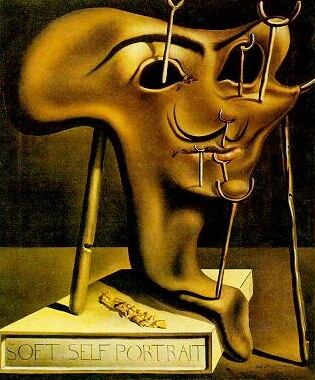
Dali's Soft Self Portrait, on which a student wrote an excellent psychoanalytic analysis based on the myth of Narcissus for her research paper last year.

Before I grade you on your class discussions on the critical theory essays on Joyce's A Portrait of the Artist as a Young Man, I would like to read your self assessment of that week--sometimes you can offer insight into my observations. I will not give you a grade until you post. Please be specific with your responses.

  1. What was your role in the small group discussions? What did you add to the group?
  2. How would you rate your performance in the large group discussion? Why?
  3. Out of all the discussions, what were the two most insightful observations that you gained from the discussion, and who made those points?

PERIOD 5 POST HERE BY MONDAY FEBRUARY 11th, 4:00p.m.

Thursday, January 31, 2008

James Joyce Critical Essay


due: February, 6th 2008 in class. Come to school early and print in the computer lab if you have trouble with your printer at home.

Late papers will lose 10pts. a day.

Scoring Guide: Critical Essay

You will also pass in all your notes and outline and rough draft for homework credit.


Requirements:


  • Paper needs to be 12pt font, Times New Roman, left justified, no spaces between paragraphs.

  • Your last name and page number of paper in Upper Right Header.

  • Margins 6.5 inches wide. 1 inch margins on all sides.

  • Minimum of 8 pages in length.

  • Title page needs to be 12pt font, Times New Roman, centered, double-spaced. It should include title, your name, my name, the course, and the date.

  • For quotations longer than 4 lines: set the quotation off by starting it on a new line and indenting each line one inch, or ten spaces, from the left margin. Do not enclose the passage in quotation marks.

  • Internal Citation must be done properly.

Papers will not be considered on time if all requirements are not met.


Your goal is to produce an original thesis about Stephen and his evolution as a character throughout the novel A Portrait of the Artist as a Young Man. You will do this by explicating three passages and applying critical theory to your analysis.


Feel free to use this space for any discussions--maybe you want to run some idea by the class and get some feedback?

Thursday, January 24, 2008

Notes from the Psychoanalytic Groups

These are the notes you all came up with in your groups...thanks again for typing and emailing me the notes. Though other groups submitted, I think this is the best version of the notes.

Psychoanalytic Criticism

· Definition: A form of criticism in which writers use psychological ideas and beliefs in order to analyze a character’s mind set and behaviors.

· Sigmund Freud: The “baby daddy” of Psychology.
· Uses the conscious and subconscious to reveal a characters wants or needs, relating back to childhood and sexual desires.
· Oedipus Complex: Fear of the father (or males in general) and desires for the mother or inadequate mother substitutes. Fear of castration and homosexuality.

Parts of the Psyche

Id- passionate, irrational, unknown, unconscious
Ego- “It” the part of the psyche that experiences and reacts to the outside world and mediates between the primitive drives of the id and the demands of the social and physical environment.
Superego- the part of the personality representing the conscience, formed in early life by internalization of the standards of parents and other models of behavior.

Writers often hide ideas and have the reader to create the meaning of these ideas using the unconscious part of the psyche to analyze these ideas.

How do writers employ such techniques?

§ Dream Sequences: When Joyce writes about Stephen visiting the strumpet. Pg 96-99 in the maroon book.
§ Tone of writing: when the “father” starts talking about the retreat and what is going to happen during it. Beginning on pages 105.
§ Allusions, illusions and delusions – throughout the book

Psychoanalytic Criticism employs three approaches:

First: It investigates the creative process of the artists: what is the nature of literary genius and how does it relate to normal mental function?
Second: psychological criticism is the psychological study of a particular artist.
Third: the analysis of fictional characters.

Notes from the Feminist Criticism Groups

These are the notes you all came up with in your groups...thanks again for typing and emailing me the notes. Though other groups submitted, I think this is the best version of the notes:

French Feminism
French Feminism drew their ideas from psychoanalytic philosopher Jaques Lacan.

1. French Feminism focuses on language and how the author creates meaning through this language
o The structure of language is phallocentric.
o Images appear in pairs, also known as binary logic.
o Son/Daughter
o Reason/Emotion
o Masculine/Feminine
o Light/Dark

2. Language is associated with the separation from the mother.
o According to the philosopher Julia Kristeva, feminine language is derived from the preoedipal period of fusion between mother and child.
o It is a method by which women may be creative in new ways.
3. The male point of view dominates culture and society.
o Women risk becoming outcasts by these new ideas.
o Men have a need to fill the gap that is created when they are separated from their mothers.
4. Helene Cixous and Luce Irigaray emphasize feminine writing as an expression of the female body.
o Addressed the issue of masculine dominance.
o An emphasis on the body either reduces “the feminine” to a biological essence or elevates it in a way that shifts the valuation of masculine and feminine but retains the binary categories.

American Feminism
In A Literature of Their Own (1977), Elaine Showalter divides women’s writing into three phases:

1. Feminine (1840-1860)
* Woman imitated the male point of view
* They imagine as if they were men in order to write and speak, or else they would have to choose silence—“the unheard sex” (100)
2. Feminist (1880-1920)
* Kate Milleht, Carolyn Heilbrun, Judith Fetterly and others created the “feminist critique”
* They on analyzing literary texts and great works by male authors
* Their revisionist rereadings led to attacks on the masculine ideas
* American feminist critics examined the characteristics of the female characters
* American feminist critics seek to expose the patriarchal society portrayed by the men
a) Dominance of men in society
b) Dominance of husbands at home
3. Female (1920-present)
* Another group of feminist critics—Sandra Gilbert, Susan Gubar, Patricia Meyer Spacks, and Elaine Showalter—created a revised feminist critique that advocated the female perspective
* They hoped to understand the women writers’ emotions and perception through the history of women and their culture
* This group of feminist critics rediscovered the forgotten works of woman writers

Weakness of American feminist criticism (1970s-1980s)
* By emphasizing the “universal female attributes” (303), the American feminists were merely countering the male opposition with the same points

British Feminism

1. British Feminists objected to the tendency of some North American critics to find universal or "essential" feminine attributes.
o They argued that differences of race, class, and culture gave rise to crucial differences among women across space and time
2. British feminist critics regarded their own critical practice as more political than that of North American feminists, emphasizing an engagement with historical process in order to promote social change
3. Believed that Americans celebrated heroes falsely; Americans suggested that powerful individuals are immune to repressive conditions.


Also, these are some good quotations from the essay from another group:

French Feminists
  • Focus on language and how meaning is produced
  • Language is typically a male realm
  • Suggested “masculine desire dominates speech and posits woman as an idealized fantasy fulfillment for the incurable emotional look cause by separation from the mother” (Jones “Inscribing” 83)
  • Feminine language is “semiotic” not “symbolic” blends mother and child
  • Men focus on one thing in life and language and sex while women focus on many things, reflecting the males’ one sexual organ to the women’s many

American

  • “American feminists critics began by analyzing literary texts rather than philosophizing abstractly about language,” (302).
  • “examined the portrayals of women characters, exposing the patricarchal ideology implicit in such works and showing how clearly this tradition of systematic masculine dominance is inscribed in our literary tradition,” (302).
  • Also discussed female authors’ “gynocriticism” and how they created a literature of their own”
    “rediscover women’s history and culture” (302).
  • Their goal was to unite feminists and bring attention to female writing
  • Women all have their own style of writing and thinking while men typically have one

British

  • More political than North American feminists
  • Believed that “American opposition to male stereotypes that denigrate women often leads to counterstereotypes of feminine virtue that ignore real differences of race, class, and culture among women,” (303-304).
  • Also “argued that American celebrations of individual heroines falsely suggest that powerful individuals may be immune to repressive conditions and may even imply that any individual can go through life unconditioned by the culture and ideology in which she or he lives, (304).
  • “British feminist theory emphasized an engagement with historical process in order to promote social change,” (304).

Friday, December 7, 2007

Passage Explication Assignment—James Joyce Period 6


For this Essay on James Joyce’s A Portrait of the Artist as a Young Man, you need to combine two passage explications to create an original thesis.

  • Your paper should be about your strand. This should be the title of the paper.
  • One passage needs to be from chapter 1 and one passage needs to be from chapter 2.
  • One passage needs to be something we have not covered in class.
  • This should be 4-6 pages, typed, double-spaced, Times New Roman.
  • Please post on the blog on Monday. Leave spaces between paragraphs for formatting.

Reminder to read the handout on passage explications and go through this process.

A passage explication is an essay that takes apart the pieces of a prose passage to demonstrate how it creates meaning – its main question can be reduced to the simple idea of “What does the passage mean? What is its purpose? How does it create that meaning and achieve its purpose? How does it fit in with the rest of the text (if available)?

Due Monday, December 10th, between 7a.m. and 7p.m.
Period 6 Post here. Period 6 Post here. Period 6 Post here.

Passage Explication Assignment—James Joyce Period 5


For this Essay on James Joyce’s A Portrait of the Artist as a Young Man, you need to combine two passage explications to create an original thesis.


  • Your paper should be about your strand. This should be the title of the paper.

  • One passage needs to be from chapter 1 and one passage needs to be from chapter 2.

  • One passage needs to be something we have not covered in class.

  • This should be 4-6 pages, typed, double-spaced, Times New Roman.

  • Please post on the blog on Monday. Leave spaces between paragraphs for formatting.
Reminder to read the handout on passage explications and go through this process.

A passage explication is an essay that takes apart the pieces of a prose passage to demonstrate how it creates meaning – its main question can be reduced to the simple idea of “What does the passage mean? What is its purpose? How does it create that meaning and achieve its purpose? How does it fit in with the rest of the text (if available)?”

Due Monday, December 10th, between 7a.m. and 7p.m.

Period 5 Post here. Period 5 Post here. Period 5 Post here.