Tuesday, October 7, 2008

Independent Reading Assignments (Memoir)


Image: Painting Title: Study for a Portrait of Van Gogh V 1957
Francis Bacon (Even great artists imitate other great artists.)


You must complete three out of five assignments. They are worth 20 points a piece. The meta-cognition will be worth 40 points—this is where you will be able to “explain a lot of your choices”, so develop all of your ideas completely.

1. Design a cover. You will be graded on the following items:

  • 10 points: Your cover should show creativity, depth in thought, and visually represent important events, themes, or symbols throughout the book. The cover should look professionally and carefully constructed. You may draw or use the computer, but be careful not to commit the visual equivalence of plagiarism.
    If you use someone else’s images, change or collage them until they are your own.
    Make sure you have a front and back cover as well as a spine.
    Spelling the author’s name wrong would be about the worst thing you could do!
  • 10 points: You should provide a 100 word description of the book on the back cover. WARNING: DO NOT PLAGIARIZE THIS!—you will risk a zero for an easy part of the requirements. Remember: the point of a 100 word description on the back of a book is to convince someone in a store to buy the book. Remember this when you write the blurb. Why should someone buy this?

∞ ∞ ∞ ∞ ∞ ∞

2. Write a “filler page”. In other words, write what happens in between two chapters or pages or rewrite a page.

  • 10 points: The details and facts in your story are factually and contextually accurate in relation to the existing story. This includes the setting and historical time frame!
  • 10 points: You successfully capture the tone and style of your author.[1]

∞ ∞ ∞ ∞ ∞ ∞

3. Rewrite a page, but include yourself. In other words, use the author’s style to write your own memoir.

  • 20 points: You successfully capture the tone and style of your author.[2]

∞ ∞ ∞ ∞ ∞ ∞

4. Passage Explication Assignment

  • 20 Points. Please refer to Passage Explication handout.

∞ ∞ ∞ ∞ ∞ ∞

5. Mix CD: The Memoir’s Soundtrack

  • 20 Points . Choose 10 songs that you think best fit the memoir (explained in “meta”), whether a connection to lyrics, the tone of mood of the song, etc. Make sure you provide me with a CD.

If you have another creative idea, propose it to me with criteria on which you would like to be graded. I must approve this first.

[1] (which includes, but is not limited to: how author presents dialogue, appropriate word choice, symbols, etc.)

[2] (which includes, but is not limited to: how author presents dialogue, appropriate word choice, symbols, etc.)

Agenda for Week of 10.6.08

Michael Stravato's photo for the New York Times: Cy Twombly at Cy Twombly Gallery in Houston in front of the gallery's largest painting, "Say Goodbye, Catullus, to the Shores of Asia Minor." June 3, 2005 (one of my favorite all-time paintings.)
Sorry for the delay in posting.

Focus: Tone, Style, and Diction (continued) & Memoir

10.6.08: Two copies of your first draft of your Creative Style Paper due in class. Begin workshop.
10.7.08: Have comments ready for the two papers you read for workshop. Memoirs should be completely read by now.
10.8.08: Due to the unfortunate nature of rotation, our class will not meet.
10.9.08: Final Draft of Style paper due, with attached Rubric and meta-cognition.
10.3.08: Independent reading project due. 3 of 5 options. You only have to do one of the options if you decide to go to the Mass Poetry Festival and write a short "review" of it on Saturday. Details to follow.

Friday, October 3, 2008

STYLE ASSIGNMENT: HEMMINGWAY VS. FAULKNER.


All assignments should be two pages typed, 1.5 spaced. You can go longer if you need, but I’m more concerned about style than you “finishing” some sort of plot—though feel free to.

Make sure you have a title.

100 points total.

• Choose a short story and “rewrite” it in the style of either Faulkner or Hemingway—if the story is “too long”, you can even just rewrite a part of it.
• Write a story in the style of either Faulkner or Hemingway based on a myth.
• Write a dialogue / or even a short story using only lines from both Faulkner and Hemingway. (Each line will need to be cited.) You will obviously be able to capture the “writing style” with this one, so you will be mostly graded on your ability to present a coherent conversation.

50 points:
• Completely matches the style of either Hemingway or Faulkner: syntax of sentences, diction, pacing, and conventions.
• Is free of unintentional spelling, typographical, and grammatical errors—this should be “publishable.”
• Completely achieves objective of prompt.
45 points:
• Matches the style of either Hemingway or Faulkner: syntax of sentences, diction, pacing, and conventions.
• Is free of unintentional spelling, typographical, and grammatical errors—this should be “publishable.
• Achieves objective of prompt.
40 points:
• Completely achieves 2 of the 3 items above.
35 points
• Mostly achieves 2 of the 3 items above.
30 points
• Is successful with one of the items above.


All papers are to be accompanied by a meta-cognitive piece (see handout), stapled to the back. This is also worth 50 points and should provide enough depth for me to see your understanding (again, refer to questions on handout.)

I will read this only after I grade the first part.

Print this rubric and place between your paper and meta-cognitive.

Tuesday, September 30, 2008

THE HEMINGWAY / FAULKNER DEBATES


If we are to believe Bloom (see handout), evaluation is the highest level of critical thinking.


I propose a simple question:


Who is the better writer, Faulkner or Hemingway?


You have joined a team of literary lawyers. You will need to divvy up the roles and responsibilities and present the following in class on Thursday:


Schedule:

  • Opening Statements: A list of grievances about the “other” writer. In fact, let’s model it (in our best legalize) after that famous list of grievances, The Declaration of Independence, and begin each objection with “Whereas…” If properly done, these should sting, be visceral and crisp. (5 minutes max, recommended one-two people.)
  • Argument #1: Explain, specifically relating to style, what makes your client a “better” writer. Explain what he does, read what he does, and explain why it works so well. (5 minutes max, recommended one-two people.)
  • Argument #2: Explain, specifically relating to style, what makes your opponents’ client a “worse” writer. Explain what he does, read what he does, and explain why it is not as effective as a style. (5 minutes max, recommended one-two people.)
  • Argument #3: Using a different example, explain, specifically relating to style, what makes your client a “better” writer. Explain what he does, read what he does, and explain why it works so well. (5 minutes max, recommended one-two people.)


Break for the Day, return Friday.


  • Counter Argument Team & Closing Arguments: You have the opportunity to refute the claims made against your client from the Opening Statements and Argument #2. In order to do this effectively, you will need to make predictions and take good notes for counter arguments. (5 minutes max, recommended two-three people.)


Please use this comment stream to post your work (after the debates)—you don’t want to show your hands before the arguments.

Sunday, September 28, 2008

College Essay Scoring Guide

Image:
Jay Defeo
Mirage 1989
oil on linen
16 x 20 inches
Estate no. E1232


50 points--Grammar, mechanics, typos, spelling, & usage. Remember, this is your only impression to show yourself through language. No matter the content of your essay, careless mistakes make you seem--well, careless. And you do not want the college admissions team to think you are apathetic. I expect you to make sure the essay is flawless. I would be happy to suggest how to phrase things grammatically better, but I should not be spending my time fixing your careless typos and spelling errors (and I won't).
  • 50 points--Writer demonstrates control of sentence structure, grammar and usage.
  • 40 points--Errors do not interfere with communication. There are few errors relative to length.
  • 30 points--Errors interfere with communication.

50 points--Insight and creativity, readability, and is your essay compelling? A note to remember your audience here and the purpose of your essay: All writers do this on some level--we consistently look at audience and purpose when we analyze writing. If you are using this to apply to college, keep in mind that the admissions officers are looking for intelligent and motivated students who will be successful at their school. Your essay should:

  • Be personal (instead of general)
  • Be concrete (instead of abstract--can you make your reader "see" your world?)
  • Include anecdote (instead of summary--this is not a resume)
  • Include a hook or lead
  • Have sophisticated and / or subtle organization
  • Show a sophisticated or subtle mastery of language
  • AND AVOID CLICHE!

PLEASE PRINT THIS PAGE OUT AND ATTACH TO THE BACK OF YOUR ESSAY SO I CAN WRITE COMMENTS. WHEN YOU PRINT, MAKE SURE YOU ONLY PRINT THIS PAGE.

College Essay Guidelines


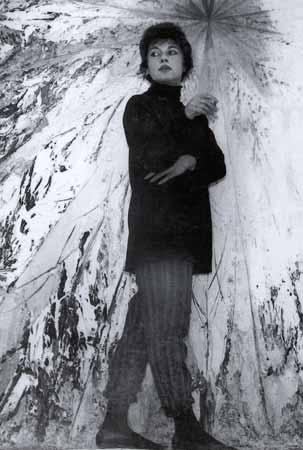
Jay De Feo 1958, one of my favorite painters, standing in front of her painting The Rose--a really amazing piece that you have to stand in front of to appreciate the intensity of it.

The prompts provided are often a starting point—it’s not really about which prompt you choose to answer, but HOW you use the topic to write an essay.

Remember Borges, “people tend to prefer the personal to the general, the concrete to the abstract”. You will notice that the questions are vague, repetitive, and general. You could almost adapt any good essay to fit a prompt.

Anyway, here are the common application prompts*

  • Evaluate a significant experience, achievement, risk you have taken, or ethical dilemma you have faced and its impact on you.
  • Discuss some issue of personal, local, national, or international concern and its importance to you.
  • Indicate a person who has had a significant influence on you, and describe that influence.
  • Describe a character in fiction, a historical figure, or a creative work (as in art, music, science, etc.) that has had an influence on you, and describe that influence.
  • A range of academic interests, personal perspectives, and life experiences adds much to the educational mix. Given your personal background, describe an experience that illustrates what you would bring to the diversity in a college community, or an encounter that demonstrated the importance of diversity to you.
  • A prompt of your choice is another option. (See below)

I’m going to break into my I’m older than you persona now: “when I applied to college I actually had to write a separate essay for each school because each school had a question—oh, and life was (of course) harder back then—we suffered like you kids nowadays have no idea of….”(Kidding of course).

Also, we will be doing some creative writing and modeling in the next couple of weeks--many students often end up using these "experiments" as their "personal essays."


* https://www.commonapp.org/CommonApp/default.aspx

Agenda for week of 9.29.08


Focus: Tone, Style, and Diction

9.29.08: You should have 2/3 of your memoirs read, with post-it notes. We will be discussing the college essay in class.
9.30.08: No school. Rosh Hashanah.
10.1.08: Read "A Clean, Well-Lighted Place" by Ernest Hemingway & "Barn Burner" by William Faulkner. Both in anthology. Take notes on stories. Pay specific attention to, well--Tone, Style, and Diction. We will be having the Hemingway vs. Faulkner debates.
10.2.08: read pgs. 154 - 157 in anthology and do two-sided notes.
10.3.08: "Style" / Creative paper due. Details to follow. Will include meta-cognitive.

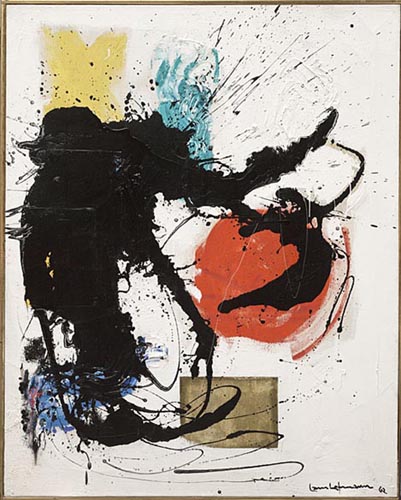
Image: Rope Swinger
Hans Hofmann
48 ¼ x 60¼"
Oil and Enamel on Canvas
1962