Tuesday, September 30, 2008

THE HEMINGWAY / FAULKNER DEBATES


If we are to believe Bloom (see handout), evaluation is the highest level of critical thinking.


I propose a simple question:


Who is the better writer, Faulkner or Hemingway?


You have joined a team of literary lawyers. You will need to divvy up the roles and responsibilities and present the following in class on Thursday:


Schedule:

  • Opening Statements: A list of grievances about the “other” writer. In fact, let’s model it (in our best legalize) after that famous list of grievances, The Declaration of Independence, and begin each objection with “Whereas…” If properly done, these should sting, be visceral and crisp. (5 minutes max, recommended one-two people.)
  • Argument #1: Explain, specifically relating to style, what makes your client a “better” writer. Explain what he does, read what he does, and explain why it works so well. (5 minutes max, recommended one-two people.)
  • Argument #2: Explain, specifically relating to style, what makes your opponents’ client a “worse” writer. Explain what he does, read what he does, and explain why it is not as effective as a style. (5 minutes max, recommended one-two people.)
  • Argument #3: Using a different example, explain, specifically relating to style, what makes your client a “better” writer. Explain what he does, read what he does, and explain why it works so well. (5 minutes max, recommended one-two people.)


Break for the Day, return Friday.


  • Counter Argument Team & Closing Arguments: You have the opportunity to refute the claims made against your client from the Opening Statements and Argument #2. In order to do this effectively, you will need to make predictions and take good notes for counter arguments. (5 minutes max, recommended two-three people.)


Please use this comment stream to post your work (after the debates)—you don’t want to show your hands before the arguments.

Sunday, September 28, 2008

College Essay Scoring Guide

Image:
Jay Defeo
Mirage 1989
oil on linen
16 x 20 inches
Estate no. E1232


50 points--Grammar, mechanics, typos, spelling, & usage. Remember, this is your only impression to show yourself through language. No matter the content of your essay, careless mistakes make you seem--well, careless. And you do not want the college admissions team to think you are apathetic. I expect you to make sure the essay is flawless. I would be happy to suggest how to phrase things grammatically better, but I should not be spending my time fixing your careless typos and spelling errors (and I won't).
  • 50 points--Writer demonstrates control of sentence structure, grammar and usage.
  • 40 points--Errors do not interfere with communication. There are few errors relative to length.
  • 30 points--Errors interfere with communication.

50 points--Insight and creativity, readability, and is your essay compelling? A note to remember your audience here and the purpose of your essay: All writers do this on some level--we consistently look at audience and purpose when we analyze writing. If you are using this to apply to college, keep in mind that the admissions officers are looking for intelligent and motivated students who will be successful at their school. Your essay should:

  • Be personal (instead of general)
  • Be concrete (instead of abstract--can you make your reader "see" your world?)
  • Include anecdote (instead of summary--this is not a resume)
  • Include a hook or lead
  • Have sophisticated and / or subtle organization
  • Show a sophisticated or subtle mastery of language
  • AND AVOID CLICHE!

PLEASE PRINT THIS PAGE OUT AND ATTACH TO THE BACK OF YOUR ESSAY SO I CAN WRITE COMMENTS. WHEN YOU PRINT, MAKE SURE YOU ONLY PRINT THIS PAGE.

College Essay Guidelines


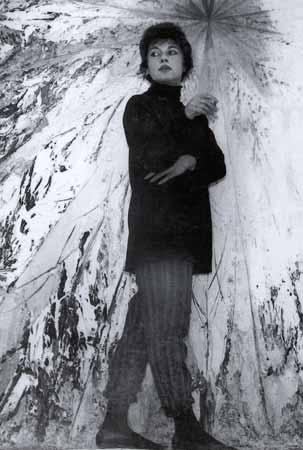
Jay De Feo 1958, one of my favorite painters, standing in front of her painting The Rose--a really amazing piece that you have to stand in front of to appreciate the intensity of it.

The prompts provided are often a starting point—it’s not really about which prompt you choose to answer, but HOW you use the topic to write an essay.

Remember Borges, “people tend to prefer the personal to the general, the concrete to the abstract”. You will notice that the questions are vague, repetitive, and general. You could almost adapt any good essay to fit a prompt.

Anyway, here are the common application prompts*

  • Evaluate a significant experience, achievement, risk you have taken, or ethical dilemma you have faced and its impact on you.
  • Discuss some issue of personal, local, national, or international concern and its importance to you.
  • Indicate a person who has had a significant influence on you, and describe that influence.
  • Describe a character in fiction, a historical figure, or a creative work (as in art, music, science, etc.) that has had an influence on you, and describe that influence.
  • A range of academic interests, personal perspectives, and life experiences adds much to the educational mix. Given your personal background, describe an experience that illustrates what you would bring to the diversity in a college community, or an encounter that demonstrated the importance of diversity to you.
  • A prompt of your choice is another option. (See below)

I’m going to break into my I’m older than you persona now: “when I applied to college I actually had to write a separate essay for each school because each school had a question—oh, and life was (of course) harder back then—we suffered like you kids nowadays have no idea of….”(Kidding of course).

Also, we will be doing some creative writing and modeling in the next couple of weeks--many students often end up using these "experiments" as their "personal essays."


* https://www.commonapp.org/CommonApp/default.aspx

Agenda for week of 9.29.08


Focus: Tone, Style, and Diction

9.29.08: You should have 2/3 of your memoirs read, with post-it notes. We will be discussing the college essay in class.
9.30.08: No school. Rosh Hashanah.
10.1.08: Read "A Clean, Well-Lighted Place" by Ernest Hemingway & "Barn Burner" by William Faulkner. Both in anthology. Take notes on stories. Pay specific attention to, well--Tone, Style, and Diction. We will be having the Hemingway vs. Faulkner debates.
10.2.08: read pgs. 154 - 157 in anthology and do two-sided notes.
10.3.08: "Style" / Creative paper due. Details to follow. Will include meta-cognitive.

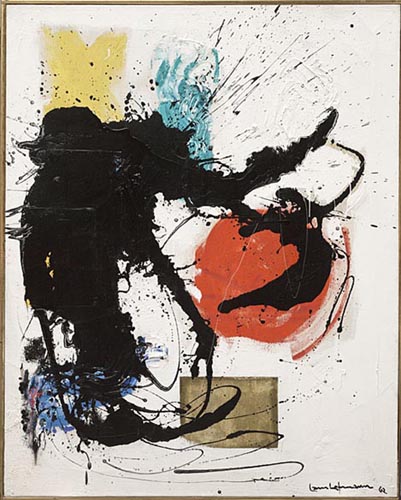
Image: Rope Swinger
Hans Hofmann
48 ¼ x 60¼"
Oil and Enamel on Canvas
1962

Wednesday, September 24, 2008

Setting Essay

here it is:

In a well-reasoned essay, explain how the setting is inextricably linked to the theme in Fay Weldon's "IND AFF".

Good luck. See you tomorrow.

Tuesday, September 23, 2008

Peer Editing Assignment for Point of View


Below this post you will find two of your classmates essays--(thank you Jenny and Cynthia). What I would like you to do, by 3:00 p.m. on Wednesday September 24th is comment on and critique both these essays. The reasons I picked these two were because I thought they were quite good (so you have something to compliment them on to start off with,) but neither of these essays received a 9 (so you can offer some advice on what may have made the papers better.) They are also about the same story, and deal with stream-of-consciousness, but attacked the prompt with two different strategies.

Image from Jess (Collins)--one of my favorite artists.

This is worth 20 "Homework Points".

You will be graded on the depth and originality (not said before you in the comment stream) of your response to the following:

  • Begin with what you saw as a strength in the essay--what was good?
  • Show where the essay could have been improved.
  • End with how the essay enhanced or changed your perception or thinking on any topic--(I know this is vague--run with it).

Your responses should be as specific as possible--cut and paste the words from the essay if you need to. You can comment on anything from the analysis to how the evidence is integrated to sentence style and structure to typos to diction to philosophical elaboration to anything that writers must consider that I have left out. Remember to carefully phrase your responses in a way that you would want to receive (because you will be here soon.)

Peace. (And keep it unfeigned.)

"Miss Brill" Point of View Essay # 1

by Jenny L


Set on a “brilliantly fine” day, readers witness the isolation of Miss Brill from her society as she struggles to play a recognizable role in it, despite a seemingly inviting environment. Katherine Mansfield’s short story of an old lady, Miss Brill, characterizes the feeling of isolation and rejection from society. Mansfield employs the use of a stream of consciousness point of view in order to exemplify the brutality of being in isolation and alienation through a relatable Miss Brill as she is confined to her own thoughts and secluded from any outside interactions. Told in such a point of view, Mansfield enhances the feelings of seclusion by allowing readers to only see, feel and hear through the thoughts of a lonely woman.


As Mansfield leads readers on a journey though the thoughts of the aged Miss Brill, her struggles to separate herself from brutal reality and a self deceiving idealism, is evident. In her evasion, she lives in her own thoughts where she shields herself from the harshness of her disconnection from society. Through her detailed recollections of the visitors in the park, her keen attention to the couples that appear, and the capacity in which her imagination takes in order to create company for her misery, it is seen that the feeling of being alone is so powerfully upsetting, that one must struggle to avoid it. Throughout the short story Miss Brill shares no physical dialogue with any of the appearing characters despite the numerous people that walks past. Miss Brill’s monologue continues as she deceives herself into believing “how fascinating it was” and “how she enjoyed it” while in reality, her loneliness is manifesting within herself. Through the use of a stream of consciousness narrative, Mansfield is able to allow readers to pry into the private thoughts of a suffering yet, proud old woman who refuses to accept her solitary state. She refuses to be defeated, and in her resistance she leads herself to self deception.


However, despite being in a “play” that “even she had a part [that] came every Sunday” the performance nonetheless must come to an end. With an “old couple”, “two young girls in red” and “two young soldiers in blue” Miss Brill cannot escape reality as she is forced to face the fact that she is alone. She, among all the “twos” and the “couples”, sits on the bench, behind a mask of thoughts struggling to blind herself from the truth. She wants to be included, play a part, be someone but it is only within her thoughts that she is. The way in which she wants reality to be is, unfortunately not her reality. Although Mansfield places Miss Brill in a fall setting “with a number of people out” and a “band [that] sounded louder and gayer”, where possibilities seem ever present, she never fully allows her to break out of her isolation and interact with others. The confinement to her thoughts disallows her any opportunity of communications with others. It is through this stream of Miss Brill’s thoughts that readers are able to truly emphasize with her and understand the cruelty of living in such a crowded world and yet feel so alone. In many ways, the point of view of Mansfield short story is to help place emphasis on one’s separation from society and the consequences its victims must face. Though the cause of Miss Brill’s loneliness is not revealed through her thoughts, she does expose that “yes, [she has] been an actress for a long time” and in that period she has been in denial of being just like the people who all appear to be “odd, silent, nearly all old, and from the way they’d stared they look as thought they’d just come from dark little rooms or even—even cupboards.” Her thoughts, no matter how much they try to deflect reality, is interrupted as a young couple, ironically deemed as “the hero and heroine”, brings her daydream to a halt. They insensitively push her back into her “cupboard”, asking “Why doesn’t she keep her silly old mug at home?”


As Mansfield’s short story of an old woman’s struggle to stay within the acceptance and inclusion of society comes to an end, it is evident that Miss Brill’s stream of thoughts which helps her to create that fantasy must come to an end as well. In the flow of ideas, one after another, in which she pretends to live a life in which she is not alone, in which she is with the old couple sitting on the bench, or the band playing lively music, it is evident that Miss Brill holds hopes of finding companionship. However this false allusion to reality is destroyed as her thoughts come to a halt. Miss Brill realizes that she is in fact alone. Mansfield captures the feeling of loneliness through Miss Brill, creating a character that expresses a feeling that everyone experiences and is able to use a point of view that constantly hints at the impact of such a feeling as it leaves one with constant thoughts of how to evade such a terrible fate.