Showing posts with label Hamlet. Show all posts

Tuesday, March 10, 2009

Cast a Character

Think of yourself as the director of Hamlet. As the director of the play/movie, you need to have a clear, developed, complete concept of your vision of the play. A director’s vision of a play should all work together: the music should echo the set, and the costumes. You may find it useful to base your concept of the play around a singular theme that you want to reinforce through set, costumes, sound, and delivery.

Assignment: Propose your vision for the play by ‘casting a character.’ (Just one.) Your development of this character needs to address the following:

  • the physical looks of the character
  • the character’s ‘costume’ (Consider colors, fit, style, time period, and texture.)
  • how the character would deliver his or her lines?

You can also address (if needed):

  • how the stage or set would look and be arranged
  • the sound effects or music that you would use in the production

You can (and maybe even should) draw, create, or link to any images to aid in your description.

But, it is answering the WHY that is at the heart of this assignment. Your ‘vision’ must be based on your knowledge and understanding of the play, so you must provide textual evidence from Hamlet to help describe why you made certain choices. Exemplary assignments will provide a strategic reading of the play, as well as develop a theory about one of the characters that could be refuted or backed up with evidence from the text.

You will be graded on the MHS Long Composition Rubric

You need to post your ‘vision’ in the comments stream by Monday, 3.16.09 @ noon. It must be 1,200 to 1,500 words long.

Monday, February 23, 2009

Hamlet Act 3 Scene 1


Act 3 Scene 1 Hamlet's Soliloquy (Laurence Olivier)


Act 3 Scene 1 Hamlet's Soliloquy (Alexander Fodor)


Act 3 Scene 1 Hamlet's Soliloquy (Kenneth Branagh)


You have until Thursday 2.26.09 @ noon to complete this assignment.

It is worth 100 points and will be graded with the APE Rubric.

Objective: Watch the following three versions from Hamlet's soliloquy from Act 3 Scene 1 and argue which of the three videos is the best video interpretation of Hamlet's state of mind. Your critique of the video must be based on your knowledge and understanding of the passage, so you must provide textual evidence from Hamlet as well as provide descriptions of the video. I can't watch the video and read your post at the same time, so you need to make me see what you see with your words. It will also help you to take notes on the video while you watch it. Pay attention to what you captures your attention. Notice what you notice!

Pay attention to:

  • delivery of the lines
  • imagery the setting / scenery
  • the portrayal of the actor
  • lighting & camera effects
  • sound effects or music

You should use the same structure for explication to develop a thesis. It should be about 1,000 words. Edit and put spaces between paragraphs before you post please!

Wednesday, February 11, 2009

Hamlet Act 2 Scene 2 (scenes from Branagh)


You have until Thursday 2.26.09 @ noon to complete this assignment.

It is worth 100 points and will be graded with the APE Rubric.

Objective: Watch the following three passages from Branagh's Hamlet from Act 2 Scene 2 and argue which of the three videos (passages) is the most important in establishing hamlet's state of mind. Your critique should address Shakespeare's purpose and intent, as well as address Branagh's interpretation of the video, which must be based on your knowledge and understanding of the passage; so you must provide textual evidence from Hamlet as well as provide descriptions of the video. I can't watch the video and read your post at the same time, so you need to make me see what you see with your words. It will also help you to take notes on the video while you watch it. Pay attention to what you captures your attention.

Notice what you notice! Pay attention to:

  • delivery of the lines
  • imagery the setting / scenery
  • the portrayal of the actor
  • lighting & camera effects
  • sound effects or music

You should use the same structure for explication to develop a thesis. It should be about 1,000 words. Edit and put spaces between paragraphs before you post please!

Wednesday, February 4, 2009

Hamlet Act 1: Scene 5

Kenneth Branagh's Hamlet (1996)

You have until Monday 2.9.09 @ noon to complete this assignment.

It is worth 100 points and will be graded with the APE Rubric.

Objective: Watch the performance above of a potion of Act 1 Scene 5 and crtique the director's interpretation of the scene.

Your critique of the video must be based on your knowledge and understanding of the passage, so you must provide textual evidence from Hamlet as well as provide descriptions of the video. I can't watch the video and read your post at the same time, so you need to make me see what you see with your words. It will also help you to take notes on the video while you watch it. Pay attention to what you captures your attention. Notice what you notice! (Hint: Watch the video more than once.)

Pay attention to:

  • delivery of the lines
  • imagery the setting / scenery
  • the portrayal of the actor (characterization)
  • lighting & camera effects
  • sound effects or music
  • etc--the list could keep going

You should make sure to develop a sophisticated thesis. Post in the comment stream of the video you choose below. It should be about 1,000 words (use your best judgement in either direction--this is a recommendation, not a requirement. It should be as long as it takes to develop your thesis.)

Edit and put spaces between paragraphs before you post please!

Hamlet Act 1: Scene 3, Ophelia, Laertes & Polonius

Michael Almereyda's Hamlet (2000) with Julia Stiles, Liev Schreiber & Bill Murray.

You have until Monday 2.9.09 @ noon to complete this assignment.

It is worth 100 points and will be graded with the APE Rubric.

Objective: Watch the performance above of a potion of Act 1 Scene 3 and crtique the director's interpretation of the scene.

Your critique of the video must be based on your knowledge and understanding of the passage, so you must provide textual evidence from Hamlet as well as provide descriptions of the video. I can't watch the video and read your post at the same time, so you need to make me see what you see with your words. It will also help you to take notes on the video while you watch it. Pay attention to what you captures your attention. Notice what you notice! (Hint: Watch the video more than once.)

Pay attention to:

  • delivery of the lines
  • imagery the setting / scenery
  • the portrayal of the actor (characterization)
  • lighting & camera effects
  • sound effects or music
  • etc--the list could keep going

You should make sure to develop a sophisticated thesis. Post in the comment stream of the video you choose below. It should be about 1,000 words (use your best judgement in either direction--this is a recommendation, not a requirement. It should be as long as it takes to develop your thesis.)

Edit and put spaces between paragraphs before you post please!

Hamet Act 1: Scene 2, the soliloquy

Kenneth Branagh as Hamlet

Laurence Olivier as Hamlet

You have until Monday 2.9.09 @ noon to complete this assignment.

It is worth 100 points and will be graded with the APE Rubric.

Objective: Watch the two performances above of Hamlet's first soliloquy from Act 1 Scene 2 and choose which version is the best interpretation of the lines.

Your critique of the video must be based on your knowledge and understanding of the passage, so you must provide textual evidence from Hamlet as well as provide descriptions of the video. I can't watch the video and read your post at the same time, so you need to make me see what you see with your words. It will also help you to take notes on the video while you watch it. Pay attention to what you captures your attention. Notice what you notice! (Hint: Watch the video more than once.)

Pay attention to:

  • delivery of the lines
  • imagery the setting / scenery
  • the portrayal of the actor (characterization)
  • lighting & camera effects
  • sound effects or music
  • etc--the list could keep going

You should make sure to develop a sophisticated thesis. Post in the comment stream of the video you choose below. It should be about 1,000 words (use your best judgement in either direction--this is a recommendation, not a requirement. It should be as long as it takes to develop your thesis.)

Edit and put spaces between paragraphs before you post please!

Monday, March 31, 2008

David Hockney's Secret Knowledge & Hamlet


So this is more of a gathering of information and some random ideas, rather than a "thesis", but thought you all might find this train of thought interesting. David Hockney (pictured below on the cover of his wonderful book SECRET KNOWLEDGE: Rediscovering the Lost Techniques of the Old Masters) presents a fascinating theory about the history of western art.


This book drew some pretty heavy criticism from some art historians because of Hockney's "radical" thesis. Hockney, a masterful artist himself, researched and theorized that there was a huge change in Western Art around 1500 a.d. Artists were painting much more "realistic" than they ever had, and Hockney argued this dramatic and sudden shift was due to a mechanical device known as the camera obscura. (see below)


As you can see from the diagram above, this was the very beginning of how a camera works and, Hockney argued, allowed the artist to "project" an image on a canvas while he painted or sketched it. Some Art Historians were bothered by this--arguing that he was somehow cheapening the work of masters, as if they were cheating. Hockney disagreed. Again, an artist himself, he argued that this was just another tool for the artist and someone still had to create these masterful images.

Hockney went further to prove his point with historical research and only something that an artist may have actually been able to capture--he started to show visually where and how the artists were employing this technique. (This is just something you'll have to read the book to see--I can only present a cheap argument. But one of the images that he begins with is Jan van Eyck's "Arnolfini Portrait":


As Wikipedia notes, "However, in the celebrated Arnolfini Portrait (London, National Gallery) reproduced at left, van Eyck inscribed on the (pictorial) back wall above the convex mirror "Johannes de Eyck fuit hic 1434" (Jan van Eyck was here, 1434). The painting is one of the most frequently analyzed by art historians, but in recent years a number of popular interpretations have been questioned."

Eventually Hockney moves on to Hans Holbein the Younger--(again more from Wikipedia): "(c. 1497– before November 29, 1543) was a German artist and printmaker who worked in a Northern Renaissance style. He is best known for his numerous portraits and his woodcut series of the Dance of Death, and is widely considered one of the finest portraitists of the Early Modern Period."

Hockney analyzes the shadows in the arras and the patterns in the tapestry to further his theory that it was produces with a camera obscura. Take a good look at it:

The Ambassadors
Hans Holbein the Younger, 1533
Oil on oak
207 × 209.5 cm
National Gallery, London


More from Wikipedia: "Although a German-born artist who spent much time in England, Holbein displayed the influence of Netherlandish painters in this work. This influence can be noted most outwardly in the use of oil paint, the use of which for panel paintings had been developed a century before in Early Netherlandish painting."


My question is: Would it have been really that crazy for Shakespeare to have seen this painting, and even pulled quite a bit of imagery from it for Hamlet? Look at the painting again....

Remember this passage from Hamlet in Act 3 Scene 4:

HAMLET:

  • Look here, upon this picture, and on this,
    The counterfeit presentment of two brothers.
    See, what a grace was seated on this brow;
    Hyperion's curls; the front of Jove himself;
    An eye like Mars, to threaten and command;
    A station like the herald Mercury
    New-lighted on a heaven-kissing hill;
    A combination and a form indeed,
    Where every god did seem to set his seal,
    To give the world assurance of a man:
    This was your husband. Look you now, what follows:
    Here is your husband; like a mildew'd ear,
    Blasting his wholesome brother. Have you eyes?
    Could you on this fair mountain leave to feed,
    And batten on this moor? Ha! have you eyes?
    You cannot call it love; for at your age
    The hey-day in the blood is tame, it's humble,
    And waits upon the judgment: and what judgment
    Would step from this to this? Sense, sure, you have,
    Else could you not have motion; but sure, that sense
    Is apoplex'd; for madness would not err,
    Nor sense to ecstasy was ne'er so thrall'd
    But it reserved some quantity of choice,
    To serve in such a difference. What devil was't
    That thus hath cozen'd you at hoodman-blind?
    Eyes without feeling, feeling without sight,
    Ears without hands or eyes, smelling sans all,
    Or but a sickly part of one true sense
    Could not so mope.O shame! where is thy blush?
    Rebellious hell,If thou canst mutine in a matron's bones,
    To flaming youth let virtue be as wax,
    And melt in her own fire: proclaim no shame
    When the compulsive ardour gives the charge,
    Since frost itself as actively doth burn
    And reason panders will.

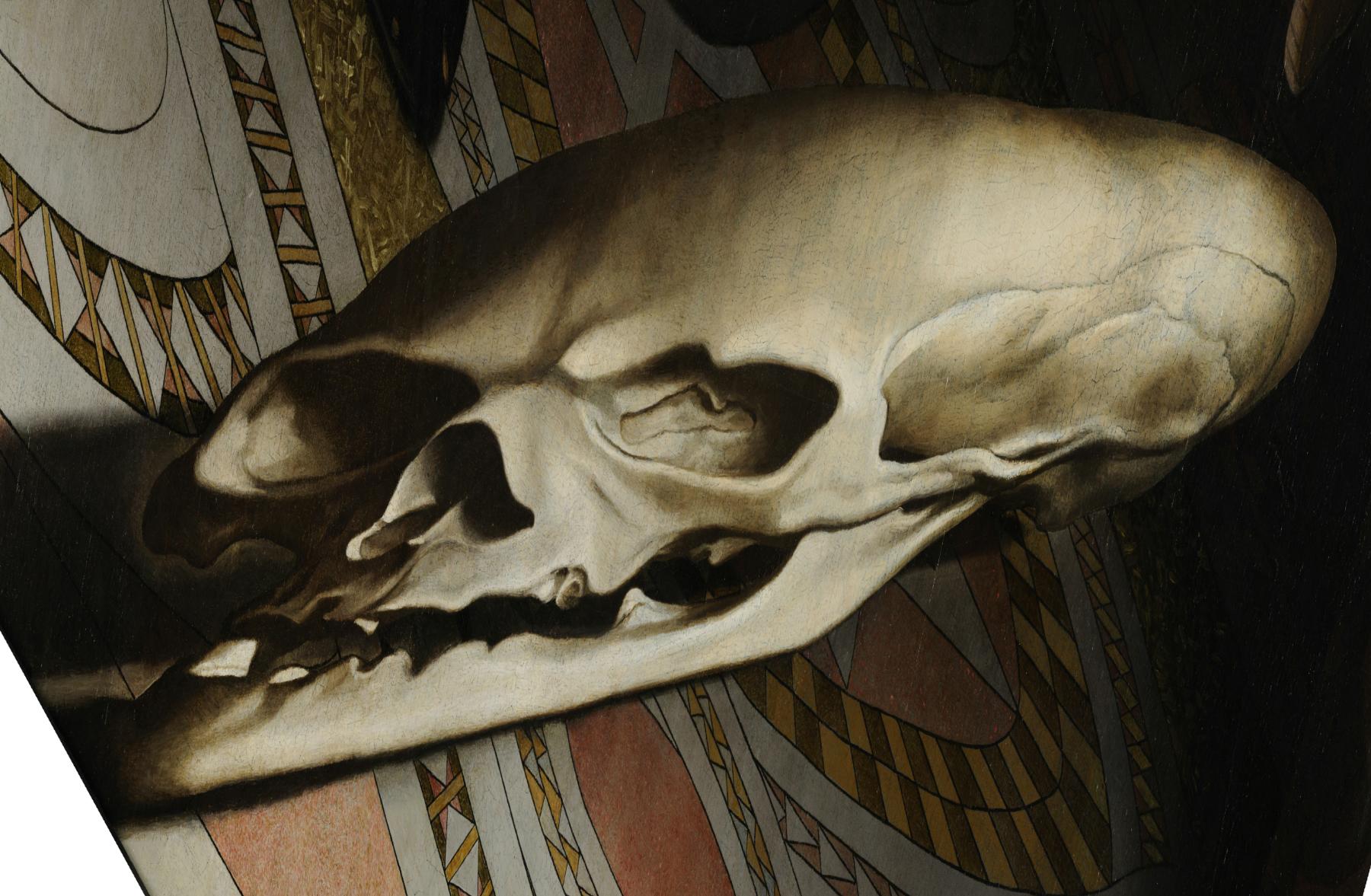
But this still doesn't solve the problem with the image. Look at the painting again. What is that formless image at the bottom of the painting?

With a little digital / optical help, if the image is cut and rotated, this is what you would see:


...more evidence of an optical device being used by the artist, but this painting also becomes a sort of symbol for Deconstructionist Theory.


That's for another blog post though...

Hamlet Study Guide

Test and Notebook due on Thursday, April 3rd
  • Vocabulary & Terms
    -tragedy (Aristotle’s Definition)
    -tragic hero (Aristotle’s Definition)
  • Character Map
    -relationships
    -status
    -attitudes
    -outcomes
  • Plot Questions
    -climax
    -order or events
  • Quote Identifications
    - class notes and dialectical journals
  • Essay
    - class notes and dialectical journals

Feel free to use this space to help each other "fill in gaps" of your notes etc.

Hamlet Act V Scene II (Kenneth Branagh)

Friday, March 21, 2008

"Pretty Ophelia--" (King Claudius) A4:S5


Natalie Dessay "Ophelia Scene"

Thought you all might be interested in this. Can anyone translate? We only have 35 minutes on Monday for our Student-Led-Discussion (due to the short period, early release day). I think it might help things if we figure out what we want to focus on before we come in--feel free to post your topic ideas and why before class. I think the Elaine Showalter essay should be helpful and incredibly interesting for your theories.

Please post your ideas for class discussion if you get a chance after reading....

Tuesday, March 11, 2008

Act 3:1 - 3:2

Most of Act 3:1 and the end of Act 3:2. Feel free to comment about what you think of this portrayal based on your developing theories of the characters involved. (You may only critique my over-acting skills if you include textual evidence from Hamlet at the beginning of Act 3:2.)

Optional of course, but I'm entirely curious...

Friday, March 7, 2008

Act 3 Scene 1 Video Critique

You have until Monday 3.10.08 night @ 11:59 to complete this assignment.
It is worth 50 points and will be graded with the open response rubric.

Objective: Watch the following three performances of Hamlet's soliloquy from Act 3 Scene 1 (probably the most famous speech ever given in literature) and choose which version is the best interpretation of the lines. Your critique of the video must be based on your knowledge and understanding of the passage, so you must provide textual evidence from Hamlet as well as provide descriptions of the video. I can't watch the video and read your post at the same time, so you need to make me see what you see with your words. It will also help you to take notes on the video while you watch it. Pay attention to what you captures your attention. Notice what you notice!

Pay attention to:
  • delivery of the lines
  • imagery the setting / scenery
  • the portrayal of the actor
  • lighting & camera effects
  • sound effects or music

You should use the same structure for explication to develop a thesis. Post in the comment stream of the video you choose below. It should be 2-3 pages before you post. Edit and put spaces between paragraphs before you post please!